• Contact info@abtriva.com for inquiries and orders.
  • Chinese (Simplified)

  • English

  • German

  • Korean

  • Spanish

United States (English / $ USD)

Rabbit anti-Human TRPM2 Polyclonal Antibody

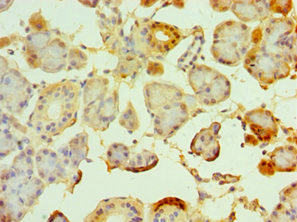
The antibody against TRPM2 was raised in rabbit using the Recombinant Human Transient receptor potential cation channel subfamily M member 2 protein (1204-1503AA) as the immunogen. This antibody exists as a non-conjugated isotype IgG, Antigen affinity purified. This antibody has been validated on ELISA, IHC.

ADC-40118A

The antibody against TRPM2 was raised in rabbit using the Recombinant Human Transient receptor potential cation channel subfamily M member 2 protein (1204-1503AA) as the immunogen. This antibody exists as a non-conjugated isotype IgG, Antigen affinity purified. This antibody has been validated on ELISA, IHC.

$299.00

Number
Order Exclusive Products Now

Request a Quote
High Purity LevelsPrecision and ReliabilityCustomization Options

Specifications


Cat.No ADC-40118A ClonalityPolyclonal
Host SpeciesRabbitTarget NameTRPM2
FormLiquidSpecies ReactivityHuman
IsotypeIgGStorage Buffer50% Glycerol, PBS with 0.02% sodium azide, pH7.3.
Purification MethodAntigen affinity purifiedConjugateNon-conjugated
ApplicationELISA, IHCStorageUpon receipt

Immunogen Information


Immunogen DescriptionRecombinant Human Transient receptor potential cation channel subfamily M member 2 protein (1204-1503AA)Target SpeciesHuman
Immunogen SequenceComplete sequences for the immunogen, target protein, and peptides are available upon request.Uniprot IDO94759
Background Information
  • Uniprot Id

    O94759

  • Target Species

    Human

  • Target Name

    TRPM2

  • Target Full Name

    Transient receptor potential cation channel subfamily M member 2

  • Target Function

    Nonselective, voltage-independent cation channel that mediates Na(+) and Ca(2+) influx, leading to increased cytoplasmic Ca(2+) levels. Functions as ligand-gated ion channel. Binding of ADP-ribose to the cytoplasmic Nudix domain causes a conformation change; the channel is primed but still requires Ca(2+) binding to trigger channel opening. Extracellular calcium passes through the channel and increases channel activity. Contributes to Ca(2+) release from intracellular stores in response to ADP-ribose. Plays a role in numerous processes that involve signaling via intracellular Ca(2+) levels. Besides, mediates the release of lysosomal Zn(2+) stores in response to reactive oxygen species, leading to increased cytosolic Zn(2+) levels. Activated by moderate heat (35 to 40 degrees Celsius). Activated by intracellular ADP-ribose, beta-NAD (NAD(+)) and similar compounds, and by oxidative stress caused by reactive oxygen or nitrogen species. The precise physiological activators are under debate; the true, physiological activators may be ADP-ribose and ADP-ribose-2'-phosphate. Activation by ADP-ribose and beta-NAD is strongly increased by moderate heat (35 to 40 degrees Celsius). Likewise, reactive oxygen species lower the threshold for activation by moderate heat (37 degrees Celsius). Plays a role in mediating behavorial and physiological responses to moderate heat and thereby contributes to body temperature homeostasis. Plays a role in insulin secretion, a process that requires increased cytoplasmic Ca(2+) levels. Required for normal IFNG and cytokine secretion and normal innate immune immunity in response to bacterial infection. Required for normal phagocytosis and cytokine release by macrophages exposed to zymosan (in vitro). Plays a role in dendritic cell differentiation and maturation, and in dendritic cell chemotaxis via its role in regulating cytoplasmic Ca(2+) levels. Plays a role in the regulation of the reorganization of the actin cytoskeleton and filopodia formation in response to reactive oxygen species via its role in increasing cytoplasmic Ca(2+) and Zn(2+) levels. Confers susceptibility to cell death following oxidative stress.; Lacks cation channel activity. Does not mediate cation transport in response to oxidative stress or ADP-ribose.; Lacks cation channel activity and negatively regulates the channel activity of isoform 1. Negatively regulates susceptibility to cell death in reposponse to oxidative stress.

  • Target Subcellular Location

    Cell membrane; Multi-pass membrane protein. Perikaryon. Cell projection. Cytoplasmic vesicle. Lysosome.; [Isoform 1]: Cell membrane; Multi-pass membrane protein.; [Isoform 2]: Cell membrane; Multi-pass membrane protein.; [Isoform 3]: Cell membrane; Multi-pass membrane protein.

  • Target Protein Families

    Transient receptor (TC 1.A.4) family, LTrpC subfamily, TRPM2 sub-subfamily

  • Target Tissue Specificity

    Highly expressed in brain and peripheral blood cells, such as neutrophils. Also detected in bone marrow, spleen, heart, liver and lung. Isoform 2 is found in neutrophil granulocytes.

  • Target Synonyms

    EREG 1; EREG1; Estrogen responsive element associated gene 1; Estrogen responsive element associated gene 1 protein; Estrogen-responsive element-associated gene 1 protein; KNP 3; KNP3; Long transient receptor potential channel 2; LTRPC 2; LTrpC-2; LTrpC2; MGC133383; NUDT9H; NUDT9L1; putative Ca2+ channel protein; putative Ca2+ channel protein; Transient receptor potential cation channel subfamily M member 2; Transient receptor potential channel 7; TRPC 7; TrpC7; TRPM 2; Trpm2; TRPM2_HUMAN

  • Target Background

    The protein encoded by this gene forms a tetrameric cation channel that is permeable to calcium, sodium, and potassium and is regulated by free intracellular ADP-ribose. The encoded protein is activated by oxidative stress and confers susceptibility to cell death. Alternative splicing results in multiple transcript variants encoding distinct protein isoforms. Additional transcript variants of this gene have been described, but their full-length nature is not known.

Inquire Rabbit anti-Human TRPM2 Polyclonal Antibody Now


AbTriva respects your privacy and protects your personal data in accordance with AbTriva. For more information, please see our data protection statement. *

Notification