-
Chinese (Simplified)
-
English
-
German
-
Korean
-
Spanish
Chinese (Simplified)
English
German
Korean
Spanish
Sign up for an account to enjoy easy online shopping and instant order tracking.
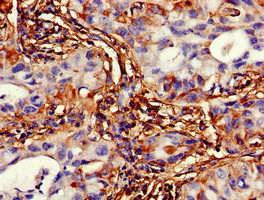
The antibody against VMP1 was raised in rabbit using the Recombinant Human Vacuole membrane protein 1 protein (136-235AA) as the immunogen. This antibody exists as a non-conjugated isotype IgG, purified by protein G with a purity greater than 95%. This antibody has been validated on ELISA, WB, IHC.
$299.00
| Cat.No | ADC-10160A | Clonality | Polyclonal |
|---|---|---|---|
| Host Species | Rabbit | Target Name | VMP1 |
| Target Synonyms | VMP1; TDC1; TMEM49; HSPC292; Vacuole membrane protein 1; Transmembrane protein 49 | Form | Liquid |
| Species Reactivity | Human, Mouse | Isotype | IgG |
| Storage Buffer | 0.01M PBS, 0.03% Proclin 300; Constituents: 50% Glycerol, PH 7.4 | Purification Method | >95%, Protein G purified |
| Conjugate | Non-conjugated | Application | ELISA, IHC, WB |
| Storage | Upon receipt |
| Immunogen Description | Recombinant Human Vacuole membrane protein 1 protein (136-235AA) | Target Species | Human |
|---|---|---|---|
| Immunogen Sequence | Complete sequences for the immunogen, target protein, and peptides are available upon request. | Uniprot ID | Q96GC9 |
Uniprot Id
Q96GC9
Target Species
Human
Target Name
VMP1
Target Full Name
Vacuole membrane protein 1
Target Function
Phospholipid scramblase involved in lipid homeostasis and membrane dynamics processes. Has phospholipid scramblase activity toward cholesterol and phosphatidylserine, as well as phosphatidylethanolamine and phosphatidylcholine. Required for autophagosome formation: participates in early stages of autophagosome biogenesis at the endoplasmic reticulum (ER) membrane by reequilibrating the leaflets of the ER as lipids are extracted by ATG2 (ATG2A or ATG2B) to mediate autophagosome assembly. Regulates ATP2A2 activity to control ER-isolation membrane contacts for autophagosome formation. In addition to autophagy, involved in other processes in which phospholipid scramblase activity is required. Modulates ER contacts with lipid droplets, mitochondria and endosomes. Plays an essential role in formation of cell junctions. Upon stress such as bacterial and viral infection, promotes formation of cytoplasmic vacuoles followed by cell death. Involved in the cytoplasmic vacuolization of acinar cells during the early stage of acute pancreatitis.; (Microbial infection) Host factor required for infection by all flaviviruses tested such as Zika virus and Yellow fever virus. Probably required post-entry of the virus to facilitate the ER membrane remodeling necessary to form replication organelles.
Target Subcellular Location
Endoplasmic reticulum-Golgi intermediate compartment membrane; Multi-pass membrane protein. Cell membrane; Multi-pass membrane protein. Vacuole membrane; Multi-pass membrane protein. Endoplasmic reticulum membrane; Multi-pass membrane protein.
Target Protein Families
VMP1 family
Target Synonyms
VMP1; TDC1; TMEM49; HSPC292; Vacuole membrane protein 1; Transmembrane protein 49
Target Background
This gene encodes a transmembrane protein that plays a key regulatory role in the process of autophagy. The ectopic overexpression of the encoded protein in cultured cells triggers autophagy even under nutrient-rich conditions. This gene is overexpressed in pancreatitis affected acinar cells where the encoded protein mediates sequestration and degradation of potentially deleterious activated zymogen granules in a process termed, zymophagy.
Notification