-
Chinese (Simplified)
-
English
-
German
-
Korean
-
Spanish
Chinese (Simplified)
English
German
Korean
Spanish
Sign up for an account to enjoy easy online shopping and instant order tracking.
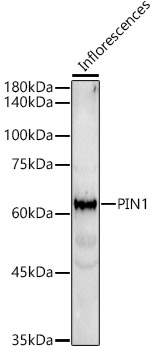
The antibody against PIN1 was raised in Rabbit using the recombinant fusion protein containing a sequence corresponding to amino acids 391-480 of arabidopsis thaliana PIN1 (NP_177500.1) as the immunogen. The polyclonal antibody exists as a isotype IgG, by affinity purification. This antibody has been validated on WB, ELISA.
| Cat.No | ADA-10628A | Clonality | Polyclonal |
|---|---|---|---|
| Host Species | Rabbit | Target Name | PIN1 |
| Target Synonyms | ARABIDOPSIS THALIANA PIN-FORMED 1; ATPIN1; F6D5.2; F6D5_2; PIN-FORMED 1; PIN1 | Form | Liquid |
| Species Reactivity | Arabidopsis thaliana | Isotype | IgG |
| Storage Buffer | 50% Glycerol, PBS with 0.05% proclin300, pH7.3. | Purification Method | Affinity purification |
| Positive Samples | Inflorescences | Application | ELISA, WB |
| Immunogen Description | Recombinant fusion protein containing a sequence corresponding to amino acids 391-480 of arabidopsis thaliana PIN1 (NP_177500.1). | Immunogen Sequence | HADYSTATNDHQKDVKISVPQGNSNDNQYVEREEFSFGNKDDDSKVLATDGGNNISNKTTQAKVMPPTSVMTRLILIMVWRKLIRNPNSY |
|---|---|---|---|
| Uniprot ID | Q9C6B8 |
Uniprot Id
Q9C6B8
Target Synonyms
ARABIDOPSIS THALIANA PIN-FORMED 1; ATPIN1; F6D5.2; F6D5_2; PIN-FORMED 1; PIN1
Target Background
Encodes an auxin efflux carrier involved in shoot and root development. It is involved in the maintenance of embryonic auxin gradients. Loss of function severely affects organ initiation, pin1 mutants are characterised by an inflorescence meristem that does not initiate any flowers, resulting in the formation of a naked inflorescence stem. PIN1 is involved in the determination of leaf shape by actively promoting development of leaf margin serrations. In roots, the protein mainly resides at the basal end of the vascular cells, but weak signals can be detected in the epidermis and the cortex. Expression levels and polarity of this auxin efflux carrier change during primordium development suggesting that cycles of auxin build-up and depletion accompany, and may direct, different stages of primordium development. PIN1 action on plant development does not strictly require function of PGP1 and PGP19 proteins.
Notification