• Contact info@abtriva.com for inquiries and orders.
  • Chinese (Simplified)

  • English

  • German

  • Korean

  • Spanish

United States (English / $ USD)

Rabbit gag-pol Polyclonal Antibody

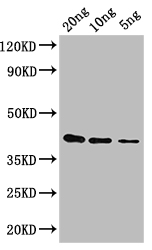
The antibody against gag-pol was raised in rabbit using the Recombinant Moloney murine leukemia virus gag-pol protein (1444-1738aa) as the immunogen. This antibody exists as a non-conjugated isotype IgG, Affinity-chromatography purified. This antibody has been validated on ELISA, WB.

ADC-54663A

The antibody against gag-pol was raised in rabbit using the Recombinant Moloney murine leukemia virus gag-pol protein (1444-1738aa) as the immunogen. This antibody exists as a non-conjugated isotype IgG, Affinity-chromatography purified. This antibody has been validated on ELISA, WB.

$299.00

Number
Order Exclusive Products Now

Request a Quote
High Purity LevelsPrecision and ReliabilityCustomization Options

Specifications


Cat.No ADC-54663A ClonalityPolyclonal
Host SpeciesRabbitTarget Namegag-pol
Target SynonymsCapsid protein p30 (CA), gag-pol, Gag-Pol polyprotein (Pr180gag-pol) [Cleaved into: Matrix protein p15 (MA), Integrase (IN) (EC 2.7.7.-) (EC 3.1.-.-) (p46)], Nucleocapsid protein p10-Pol (NC-pol), Protease (PR) (EC 3.4.23.-) (p14), Reverse transcriptase/ribonuclease H (RT) (EC 2.7.7.49) (EC 2.7.7.7) (EC 3.1.26.4) (p80), RNA-binding phosphoprotein p12 (pp12)FormLiquid
Species ReactivityMoloney murine leukemia virusIsotypeIgG
Storage Buffer0.01M PBS, 0.03% Proclin 300; Constituents: 50% Glycerol, PH 7.4Purification MethodAffinity-chromatography purified
ConjugateNon-conjugatedApplicationELISA, WB
StorageUpon receipt

Immunogen Information


Immunogen DescriptionRecombinant Moloney murine leukemia virus gag-pol protein (1444-1738aa)Target SpeciesMoloney murine leukemia virus (isolate Shinnick) (MoMLV)
Immunogen SequenceComplete sequences for the immunogen, target protein, and peptides are available upon request.Uniprot IDP03355
Background Information
  • Uniprot Id

    P03355

  • Target Species

    Moloney murine leukemia virus

  • Target Name

    GAG-POL

  • Target Function

    Plays a role in budding and is processed by the viral protease during virion maturation outside the cell. During budding, it recruits, in a PPXY-dependent or independent manner, Nedd4-like ubiquitin ligases that conjugate ubiquitin molecules to Gag-Pol, or to Gag-Pol binding host factors. Interaction with HECT ubiquitin ligases probably links the viral protein to the host ESCRT pathway and facilitates release.; Targets Gag and gag-pol polyproteins to the plasma membrane via a multipartite membrane binding signal, that includes its myristoylated N-terminus. Also mediates nuclear localization of the pre-integration complex.; Constituent of the pre-integration complex (PIC) which tethers the latter to mitotic chromosomes. This allows the integration of the viral genome into the host DNA.; Forms the spherical core of the virion that encapsulates the genomic RNA-nucleocapsid complex.; Involved in the packaging and encapsidation of two copies of the genome. Binds with high affinity to conserved UCUG elements within the packaging signal, located near the 5'-end of the genome. This binding is dependent on genome dimerization. Acts as a nucleic acid chaperone which is involved in rearrangement of nucleic acid secondary structures during gRNA retrotranscription.; The aspartyl protease mediates proteolytic cleavages of Gag and Gag-Pol polyproteins during or shortly after the release of the virion from the plasma membrane. Cleavages take place as an ordered, step-wise cascade to yield mature proteins. This process is called maturation. Displays maximal activity during the budding process just prior to particle release from the cell (Potential). Cleaves the translation initiation factor eIF4G leading to the inhibition of host cap-dependent translation.; RT is a multifunctional enzyme that converts the viral dimeric RNA genome into dsDNA in the cytoplasm, shortly after virus entry into the cell. This enzyme displays a DNA polymerase activity that can copy either DNA or RNA templates, and a ribonuclease H (RNase H) activity that cleaves the RNA strand of RNA-DNA heteroduplexes in a partially processive 3' to 5' endonucleasic mode. Conversion of viral genomic RNA into dsDNA requires many steps. A tRNA binds to the primer-binding site (PBS) situated at the 5' end of the viral RNA. RT uses the 3' end of the tRNA primer to perform a short round of RNA-dependent minus-strand DNA synthesis. The reading proceeds through the U5 region and ends after the repeated (R) region which is present at both ends of viral RNA. The portion of the RNA-DNA heteroduplex is digested by the RNase H, resulting in a ssDNA product attached to the tRNA primer. This ssDNA/tRNA hybridizes with the identical R region situated at the 3' end of viral RNA. This template exchange, known as minus-strand DNA strong stop transfer, can be either intra- or intermolecular. RT uses the 3' end of this newly synthesized short ssDNA to perform the RNA-dependent minus-strand DNA synthesis of the whole template. RNase H digests the RNA template except for a polypurine tract (PPT) situated at the 5' end of the genome. It is not clear if both polymerase and RNase H activities are simultaneous. RNase H probably can proceed both in a polymerase-dependent (RNA cut into small fragments by the same RT performing DNA synthesis) and a polymerase-independent mode (cleavage of remaining RNA fragments by free RTs). Secondly, RT performs DNA-directed plus-strand DNA synthesis using the PPT that has not been removed by RNase H as primers. PPT and tRNA primers are then removed by RNase H. The 3' and 5' ssDNA PBS regions hybridize to form a circular dsDNA intermediate. Strand displacement synthesis by RT to the PBS and PPT ends produces a blunt ended, linear dsDNA copy of the viral genome that includes long terminal repeats (LTRs) at both ends.; Catalyzes viral DNA integration into the host chromosome, by performing a series of DNA cutting and joining reactions. This enzyme activity takes place after virion entry into a cell and reverse transcription of the RNA genome in dsDNA. The first step in the integration process is 3' processing. This step requires a complex comprising the viral genome, matrix protein and integrase. This complex is called the pre-integration complex (PIC). The integrase protein removes 2 nucleotides from each 3' end of the viral DNA, leaving recessed CA OH's at the 3' ends. In the second step that requires cell division, the PIC enters cell nucleus. In the third step, termed strand transfer, the integrase protein joins the previously processed 3' ends to the 5' ends of strands of target cellular DNA at the site of integration. The last step is viral DNA integration into host chromosome.

  • Target Subcellular Location

    [Gag-Pol polyprotein]: Virion. Host cell membrane; Lipid-anchor. Host late endosome membrane; Lipid-anchor. Host endosome, host multivesicular body.; [Matrix protein p15]: Virion.; [Capsid protein p30]: Virion.; [Nucleocapsid protein p10-Pol]: Virion.; [Protease]: Virion.; [RNA-binding phosphoprotein p12]: Host cytoplasm.

Inquire Rabbit gag-pol Polyclonal Antibody Now


AbTriva respects your privacy and protects your personal data in accordance with AbTriva. For more information, please see our data protection statement. *

Notification