-
Chinese (Simplified)
-
English
-
German
-
Korean
-
Spanish

Chinese (Simplified)
English
German
Korean
Spanish
Sign up for an account to enjoy easy online shopping and instant order tracking.
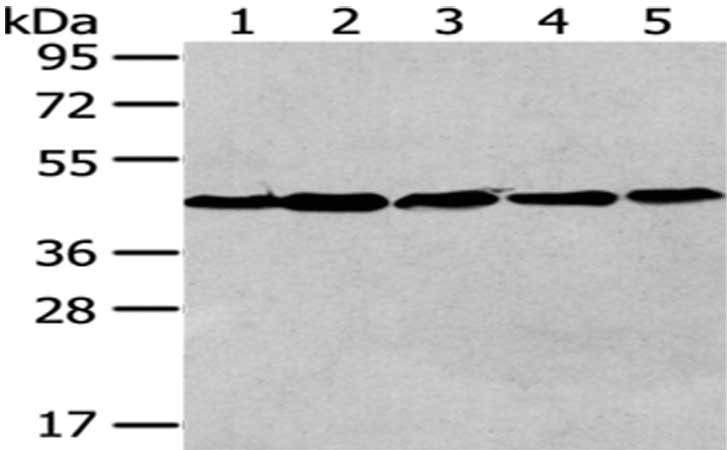
The antibody against VPS4A was raised in rabbit using the Synthetic peptide of Human VPS4A as the immunogen. This antibody exists as a non-conjugated isotype IgG, Antigen affinity purified. This antibody has been validated on ELISA, WB, IHC.
$299.00
| Cat.No | ADC-25520A | Clonality | Polyclonal |
|---|---|---|---|
| Host Species | Rabbit | Target Name | VPS4A |
| Form | Liquid | Species Reactivity | Human, Mouse, Rat |
| Isotype | IgG | Storage Buffer | 0.05% NaN3, 40% Glycerol., pH7.4 PBS |
| Purification Method | Antigen affinity purified | Conjugate | Non-conjugated |
| Application | ELISA, IHC, WB | Storage | Upon receipt |
| Immunogen Description | Synthetic peptide of Human VPS4A | Target Species | Human |
|---|---|---|---|
| Immunogen Sequence | Complete sequences for the immunogen, target protein, and peptides are available upon request. | Uniprot ID | Q9UN37 |
Uniprot Id
Q9UN37
Target Species
Human
Target Name
VPS4A
Target Full Name
Vacuolar protein sorting-associated protein 4A
Target Function
Involved in late steps of the endosomal multivesicular bodies (MVB) pathway. Recognizes membrane-associated ESCRT-III assemblies and catalyzes their disassembly, possibly in combination with membrane fission. Redistributes the ESCRT-III components to the cytoplasm for further rounds of MVB sorting. MVBs contain intraluminal vesicles (ILVs) that are generated by invagination and scission from the limiting membrane of the endosome and mostly are delivered to lysosomes enabling degradation of membrane proteins, such as stimulated growth factor receptors, lysosomal enzymes and lipids. Involved in cytokinesis: retained at the midbody by ZFYVE19/ANCHR and CHMP4C until abscission checkpoint signaling is terminated at late cytokinesis. It is then released following dephosphorylation of CHMP4C, leading to abscission. VPS4A/B are required for the exosomal release of SDCBP, CD63 and syndecan.; (Microbial infection) In conjunction with the ESCRT machinery also appears to function in topologically equivalent membrane fission events, such as the terminal stages of cytokinesis and enveloped virus budding (HIV-1 and other lentiviruses).
Target Subcellular Location
Late endosome membrane; Peripheral membrane protein. Midbody.
Target Protein Families
AAA ATPase family
Target Tissue Specificity
Ubiquitously expressed.
Target Research Area
Others
Target Synonyms
hVPS4; Protein SKD2; SKD1; SKD1 homolog; SKD1A; SKD2; Vacuolar protein sorting 4 homolog A; Vacuolar protein sorting 4, yeast, homolog of, A; Vacuolar protein sorting factor 4A; Vacuolar protein sorting-associated protein 4A; vacuolar sorting protein 4; VPS4; VPS4-1; Vps4a; VPS4A_HUMAN
Target Background
The protein encoded by this gene is a member of the AAA protein family (ATPases associated with diverse cellular activities), and is the homolog of the yeast Vps4 protein. In humans, two paralogs of the yeast protein have been identified. The former share a high degree of aa sequence similarity with each other, and also with yeast Vps4 and mouse Skd1 proteins. The mouse Skd1 (suppressor of K+ transport defect 1) has been shown to be really an yeast Vps4 ortholog. Functional studies indicate that both human paralogs associate with the endosomal compartments, and are involved in intracellular protein trafficking, similar to Vps4 protein in yeast. The gene encoding this paralog has been mapped to chromosome 16; the gene for the other resides on chromosome 18.
Notification