-
Chinese (Simplified)
-
English
-
German
-
Korean
-
Spanish

Chinese (Simplified)
English
German
Korean
Spanish
Sign up for an account to enjoy easy online shopping and instant order tracking.
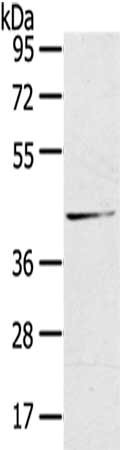
The antibody against HSD11B2 was raised in rabbit using the Synthetic peptide of Human HSD11B2 as the immunogen. This antibody exists as a non-conjugated isotype IgG, Antigen affinity purified. This antibody has been validated on ELISA, WB, IHC.
$299.00
| Cat.No | ADC-26585A | Clonality | Polyclonal |
|---|---|---|---|
| Host Species | Rabbit | Target Name | HSD11B2 |
| Form | Liquid | Species Reactivity | Human |
| Isotype | IgG | Storage Buffer | 0.05% NaN3, 40% Glycerol., pH7.4 PBS |
| Purification Method | Antigen affinity purified | Conjugate | Non-conjugated |
| Application | ELISA, IHC, WB | Storage | Upon receipt |
| Immunogen Description | Synthetic peptide of Human HSD11B2 | Target Species | Human |
|---|---|---|---|
| Immunogen Sequence | Complete sequences for the immunogen, target protein, and peptides are available upon request. | Uniprot ID | P80365 |
Uniprot Id
P80365
Target Species
Human
Target Name
HSD11B2
Target Full Name
11-beta-hydroxysteroid dehydrogenase type 2
Target Function
Catalyzes the conversion of cortisol to the inactive metabolite cortisone. Modulates intracellular glucocorticoid levels, thus protecting the nonselective mineralocorticoid receptor from occupation by glucocorticoids.
Target Involvement
Apparent mineralocorticoid excess (AME)
Target Subcellular Location
Microsome. Endoplasmic reticulum.
Target Protein Families
Short-chain dehydrogenases/reductases (SDR) family
Target Tissue Specificity
Expressed in kidney, pancreas, prostate, ovary, small intestine and colon. At midgestation, expressed at high levels in placenta and in fetal kidney and, at much lower levels, in fetal lung and testis.
Target Research Area
Cancer
Target Synonyms
11 beta HSD2; 11 beta hydroxysteroid dehydrogenase type 2; 11 DH2; 11-beta-HSD2; 11-beta-hydroxysteroid dehydrogenase type 2; 11-DH2; AME; AME1; Corticosteroid 11 beta dehydrogenase isozyme 2; Corticosteroid 11-beta-dehydrogenase isozyme 2; DHI2_HUMAN; HSD11B2; HSD11K; HSD2; Hydroxysteroid 11 beta dehydrogenase 2; Hydroxysteroid 11 beta dehydrogenase isoenzyme 2; NAD dependent 11 beta hydroxysteroid dehydrogenase ; NAD-dependent 11-beta-hydroxysteroid dehydrogenase; SDR9C3; Short chain dehydrogenase/reductase family 9C; member 3
Target Background
There are at least two isozymes of the corticosteroid 11-beta-dehydrogenase, a microsomal enzyme complex responsible for the interconversion of cortisol and cortisone. The type I isozyme has both 11-beta-dehydrogenase (cortisol to cortisone) and 11-oxoreductase (cortisone to cortisol) activities. The type II isozyme, encoded by this gene, has only 11-beta-dehydrogenase activity. In aldosterone-selective epithelial tissues such as the kidney, the type II isozyme catalyzes the glucocorticoid cortisol to the inactive metabolite cortisone, thus preventing illicit activation of the mineralocorticoid receptor. In tissues that do not express the mineralocorticoid receptor, such as the placenta and testis, it protects cells from the growth-inhibiting and/or pro-apoptotic effects of cortisol, particularly during embryonic development. Mutations in this gene cause the syndrome of apparent mineralocorticoid excess and hypertension.
Notification