-
Chinese (Simplified)
-
English
-
German
-
Korean
-
Spanish

Chinese (Simplified)
English
German
Korean
Spanish
Sign up for an account to enjoy easy online shopping and instant order tracking.
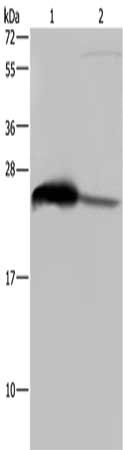
The antibody against GSTA3 was raised in rabbit using the Fusion protein of Human GSTA3 as the immunogen. This antibody exists as a non-conjugated isotype IgG, Antigen affinity purified. This antibody has been validated on ELISA, WB, IHC.
$299.00
| Cat.No | ADC-29925A | Clonality | Polyclonal |
|---|---|---|---|
| Host Species | Rabbit | Target Name | GSTA3 |
| Form | Liquid | Species Reactivity | Human |
| Isotype | IgG | Storage Buffer | 0.05% NaN3, 40% Glycerol., pH7.4 PBS |
| Purification Method | Antigen affinity purified | Conjugate | Non-conjugated |
| Application | ELISA, IHC, WB | Storage | Upon receipt |
| Immunogen Description | Fusion protein of Human GSTA3 | Target Species | Human |
|---|---|---|---|
| Immunogen Sequence | Complete sequences for the immunogen, target protein, and peptides are available upon request. | Uniprot ID | Q16772 |
Uniprot Id
Q16772
Target Species
Human
Target Name
GSTA3
Target Full Name
Glutathione S-transferase A3
Target Function
Conjugation of reduced glutathione to a wide number of exogenous and endogenous hydrophobic electrophiles. Catalyzes isomerization reactions that contribute to the biosynthesis of steroid hormones. Efficiently catalyze obligatory double-bond isomerizations of delta(5)-androstene-3,17-dione and delta(5)-pregnene-3,20-dione, precursors to testosterone and progesterone, respectively. Has substantial activity toward aflatoxin B1-8,9-epoxide.
Target Subcellular Location
Cytoplasm.
Target Protein Families
GST superfamily, Alpha family
Target Synonyms
Glutathione S alkyltransferase A3; Glutathione S aralkyltransferase A3; Glutathione S aryltransferase A3; Glutathione S transferase A3 3; Glutathione S transferase A3; glutathione S transferase A3 subunit; Glutathione S transferase alpha 3; Glutathione S transferase alpha type (Ya); glutathione S transferase Yc 1; glutathione S transferase Yc1 subunit; Glutathione S-transferase A3; Glutathione S-transferase A3-3; Glutathione S-transferase Ya3; Glutathione S-transferase Yc; glutathione transferase A3 subunit; Glutathione transferase alpha 3; GST 2 2; GST AA; GST class alpha; GST class alpha member 3; GST class-alpha member 3; GST Yc1; GSTA 3; GSTA3 3; Gsta3; GSTA3-3; GSTA3_HUMAN; Gstyc; GTA 3; GTA3; MGC22232; S (hydroxyalkyl)glutathione lyase A3; Yc1
Target Background
Cytosolic and membrane-bound forms of glutathione S-transferase are encoded by two distinct supergene families. These enzymes are involved in cellular defense against toxic, carcinogenic, and pharmacologically active electrophilic compounds. At present, eight distinct classes of the soluble cytoplasmic mammalian glutathione S-transferases have been identified: alpha, kappa, mu, omega, pi, sigma, theta and zeta. This gene encodes a glutathione S-tranferase belonging to the alpha class genes that are located in a cluster mapped to chromosome 6. Genes of the alpha class are highly related and encode enzymes with glutathione peroxidase activity. However, during evolution, this alpha class gene diverged accumulating mutations in the active site that resulted in differences in substrate specificity and catalytic activity. The enzyme encoded by this gene catalyzes the double bond isomerization of precursors for progesterone and testosterone during the biosynthesis of steroid hormones. An additional transcript variant has been identified, but its full length sequence has not been determined.
Notification