• Contact info@abtriva.com for inquiries and orders.
  • Chinese (Simplified)

  • English

  • German

  • Korean

  • Spanish

United States (English / $ USD)

Rabbit anti-Human SEPT7 Polyclonal Antibody

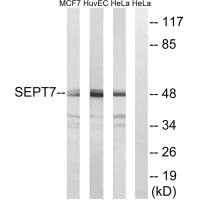
The antibody against SEPT7 was raised in rabbit using the Synthesized peptide derived from internal of Human SEPT7. as the immunogen. The antibody was affinity-purified from rabbit antiserum by affinity-chromatography using epitope-specific immunogen. This antibody has been validated on ELISA, WB.

ADC-40935A

The antibody against SEPT7 was raised in rabbit using the Synthesized peptide derived from internal of Human SEPT7. as the immunogen. The antibody was affinity-purified from rabbit antiserum by affinity-chromatography using epitope-specific immunogen. This antibody has been validated on ELISA, WB.

$297.00

Number
Order Exclusive Products Now

Request a Quote
High Purity LevelsPrecision and ReliabilityCustomization Options

Specifications


Cat.No ADC-40935A ClonalityPolyclonal
Host SpeciesRabbitTarget NameSEPT7
FormLiquidSpecies ReactivityHuman, Mouse
Storage BufferPH 7.4, 0.02% sodium azide and 50% glycerol., 150mM NaCl, Rabbit IgG in phosphate buffered saline (without Mg2+ and Ca2+)Purification MethodThe antibody was affinity-purified from rabbit antiserum by affinity-chromatography using epitope-specific immunogen.
ApplicationELISA, WBStorageUpon receipt

Immunogen Information


Immunogen DescriptionSynthesized peptide derived from internal of Human SEPT7.Target SpeciesHuman
Immunogen SequenceComplete sequences for the immunogen, target protein, and peptides are available upon request.Uniprot IDQ16181
Background Information
  • Uniprot Id

    Q16181

  • Target Species

    Human

  • Target Name

    SEPT7

  • Target Full Name

    Septin-7

  • Target Function

    Filament-forming cytoskeletal GTPase. Required for normal organization of the actin cytoskeleton. Required for normal progress through mitosis. Involved in cytokinesis. Required for normal association of CENPE with the kinetochore. Plays a role in ciliogenesis and collective cell movements. Forms a filamentous structure with SEPTIN12, SEPTIN6, SEPTIN2 and probably SEPTIN4 at the sperm annulus which is required for the structural integrity and motility of the sperm tail during postmeiotic differentiation.

  • Target Subcellular Location

    Cytoplasm. Chromosome, centromere, kinetochore. Cytoplasm, cytoskeleton, spindle. Cleavage furrow. Midbody. Cytoplasm, cytoskeleton, cilium axoneme. Cell projection, cilium, flagellum.

  • Target Protein Families

    TRAFAC class TrmE-Era-EngA-EngB-Septin-like GTPase superfamily, Septin GTPase family

  • Target Tissue Specificity

    Widely expressed.

  • Target Research Area

    Cell Biology

  • Target Synonyms

    CDC10; CDC10 protein homolog; CDC3; Cell division cycle 10; NBLA02942; SEPT7; SEPT7_HUMAN; SEPT7A; Septin 7; Septin-7

  • Target Background

    This gene encodes a protein that is highly similar to the CDC10 protein of Saccharomyces cerevisiae. The protein also shares similarity with Diff 6 of Drosophila and with H5 of mouse. Each of these similar proteins, including the yeast CDC10, contains a GTP-binding motif. The yeast CDC10 protein is a structural component of the 10 nm filament which lies inside the cytoplasmic membrane and is essential for cytokinesis. This human protein functions in gliomagenesis and in the suppression of glioma cell growth, and it is required for the association of centromere-associated protein E with the kinetochore. Alternative splicing results in multiple transcript variants. Several related pseudogenes have been identified on chromosomes 5, 7, 9, 10, 11, 14, 17 and 19.

Inquire Rabbit anti-Human SEPT7 Polyclonal Antibody Now


AbTriva respects your privacy and protects your personal data in accordance with AbTriva. For more information, please see our data protection statement. *

Notification