-
Chinese (Simplified)
-
English
-
German
-
Korean
-
Spanish
Chinese (Simplified)
English
German
Korean
Spanish
Sign up for an account to enjoy easy online shopping and instant order tracking.
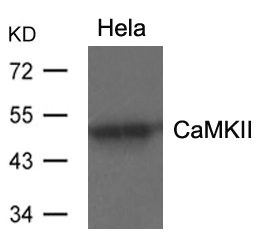
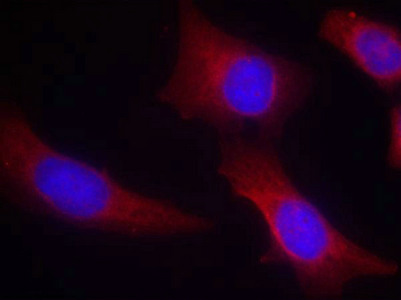
The antibody against CAMK2A was raised in rabbit using the Peptide sequence around aa.284~288 (Q-E-T-V-D) derived from Human CaMKII. as the immunogen. Antibodies were produced by immunizing rabbits with synthetic peptide and KLH conjugates. Antibodies were purified by affinity-chromatography using epitope-specific peptide. This antibody has been validated on ELISA, WB, IF.
$297.00
| Cat.No | ADC-43331A | Clonality | Polyclonal |
|---|---|---|---|
| Host Species | Rabbit | Target Name | CAMK2A |
| Form | Liquid | Species Reactivity | Human, Mouse, Rat |
| Storage Buffer | PH 7.4, 0.02% sodium azide and 50% glycerol., 150mM NaCl, Supplied at 1.0mg/mL in phosphate buffered saline (without Mg2+ and Ca2+) | Purification Method | Antibodies were produced by immunizing rabbits with synthetic peptide and KLH conjugates. Antibodies were purified by affinity-chromatography using epitope-specific peptide. |
| Application | ELISA, IF, WB | Storage | Upon receipt |
| Immunogen Description | Peptide sequence around aa.284~288 (Q-E-T-V-D) derived from Human CaMKII. | Target Species | Human |
|---|---|---|---|
| Immunogen Sequence | Complete sequences for the immunogen, target protein, and peptides are available upon request. | Uniprot ID | Q9UQM7 |
Uniprot Id
Q9UQM7
Target Species
Human
Target Name
CAMK2A
Target Full Name
Calcium/calmodulin-dependent protein kinase type II subunit alpha
Target Function
Calcium/calmodulin-dependent protein kinase that functions autonomously after Ca(2+)/calmodulin-binding and autophosphorylation, and is involved in synaptic plasticity, neurotransmitter release and long-term potentiation. Member of the NMDAR signaling complex in excitatory synapses, it regulates NMDAR-dependent potentiation of the AMPAR and therefore excitatory synaptic transmission. Regulates dendritic spine development. Also regulates the migration of developing neurons. Phosphorylates the transcription factor FOXO3 to activate its transcriptional activity. Acts as a negative regulator of 2-arachidonoylglycerol (2-AG)-mediated synaptic signaling via modulation of DAGLA activity.
Target Subcellular Location
Cell junction, synapse. Cell junction, synapse, postsynaptic density. Cell projection, dendritic spine. Cell projection, dendrite.
Target Protein Families
Protein kinase superfamily, CAMK Ser/Thr protein kinase family, CaMK subfamily
Target Synonyms
Calcium/calmodulin dependent protein kinase II alpha; Calcium/calmodulin dependent protein kinase II beta; Calcium/calmodulin dependent protein kinase II delta; Calcium/calmodulin dependent protein kinase II gamma; Calcium/calmodulin-dependent protein kinase type II subunit alpha; CaM kinase II alpha; CaM kinase II; CaM kinase II beta; CaM kinase II delta; CaM kinase II gamma; CaM kinase II subunit alpha; CaMK-II subunit alpha; CAMK2; Camk2a; CAMK2B; CAMK2D; CAMK2G; CAMKA; KCC2A_HUMAN
Target Background
The product of this gene belongs to the serine/threonine protein kinases family, and to the Ca(2+)/calmodulin-dependent protein kinases subfamily. Calcium signaling is crucial for several aspects of plasticity at glutamatergic synapses. This calcium calmodulin-dependent protein kinase is composed of four different chains: alpha, beta, gamma, and delta. The alpha chain encoded by this gene is required for hippocampal long-term potentiation (LTP) and spatial learning. In addition to its calcium-calmodulin (CaM)-dependent activity, this protein can undergo autophosphorylation, resulting in CaM-independent activity. Several transcript variants encoding distinct isoforms have been identified for this gene.
Notification