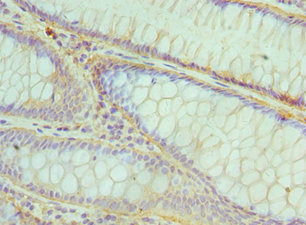
-
Chinese (Simplified)
-
English
-
German
-
Korean
-
Spanish

Chinese (Simplified)
English
German
Korean
Spanish
Sign up for an account to enjoy easy online shopping and instant order tracking.
The antibody against CBFB was raised in rabbit using the Recombinant Human Core-binding factor subunit beta protein (1-182AA) as the immunogen. This antibody exists as a non-conjugated isotype IgG, Antigen affinity purified. This antibody has been validated on ELISA, IHC.
$299.00
| Cat.No | ADC-45212A | Clonality | Polyclonal |
|---|---|---|---|
| Host Species | Rabbit | Target Name | CBFB |
| Target Synonyms | beta subunit (CBFB) | Form | Liquid |
| Species Reactivity | Human | Isotype | IgG |
| Storage Buffer | 50% Glycerol, PBS with 0.02% sodium azide, pH7.3. | Purification Method | Antigen affinity purified |
| Conjugate | Non-conjugated | Application | ELISA, IHC |
| Storage | Upon receipt |
| Immunogen Description | Recombinant Human Core-binding factor subunit beta protein (1-182AA) | Target Species | Human |
|---|---|---|---|
| Immunogen Sequence | Complete sequences for the immunogen, target protein, and peptides are available upon request. | Uniprot ID | Q13951 |
Uniprot Id
Q13951
Target Species
Human
Target Name
CBFB
Target Full Name
Core-binding factor subunit beta
Target Function
Forms the heterodimeric complex core-binding factor (CBF) with RUNX family proteins (RUNX1, RUNX2, and RUNX3). RUNX members modulate the transcription of their target genes through recognizing the core consensus binding sequence 5'-TGTGGT-3', or very rarely, 5'-TGCGGT-3', within their regulatory regions via their runt domain, while CBFB is a non-DNA-binding regulatory subunit that allosterically enhances the sequence-specific DNA-binding capacity of RUNX. The heterodimers bind to the core site of a number of enhancers and promoters, including murine leukemia virus, polyomavirus enhancer, T-cell receptor enhancers, LCK, IL3 and GM-CSF promoters. CBF complexes repress ZBTB7B transcription factor during cytotoxic (CD8+) T cell development. They bind to RUNX-binding sequence within the ZBTB7B locus acting as transcriptional silencer and allowing for cytotoxic T cell differentiation.
Target Involvement
A chromosomal aberration involving CBFB is associated with acute myeloid leukemia of M4EO subtype. Pericentric inversion inv(16)(p13;q22). The inversion produces a fusion protein that consists of the 165 N-terminal residues of CBF-beta (PEPB2) with the tail region of MYH11.
Target Subcellular Location
Nucleus.
Target Protein Families
CBF-beta family
Target Research Area
Epigenetics and Nuclear Signaling
Target Synonyms
CBF b; CBF beta; CBF-beta; CBFB; CBFbeta; Core binding factor beta subunit; core binding factor subunit beta; Core-binding factor subunit beta; Core-binding factor, beta subunit (CBFB), transcript variant 2; PEA 2; PEA2; PEA2 beta; PEA2-beta; PEA2beta; PEBB_HUMAN; PEBP 2B; PEBP2 beta; PEBP2-beta; PEBP2B; PEBP2beta; Polyomavirus enhancer binding protein 2 beta subunit ; Polyomavirus enhancer-binding protein 2 beta subunit; SL3 3 enhancer factor 1 beta subunit; SL3 3 enhancer factor 1 subunit beta; SL3-3 enhancer factor 1 subunit beta; SL3/AKV core binding factor beta subunit; SL3/AKV core-binding factor beta subunit
Target Background
The protein encoded by this gene is the beta subunit of a heterodimeric core-binding transcription factor belonging to the PEBP2/CBF transcription factor family which master-regulates a host of genes specific to hematopoiesis (e.g., RUNX1) and osteogenesis (e.g., RUNX2). The beta subunit is a non-DNA binding regulatory subunit; it allosterically enhances DNA binding by alpha subunit as the complex binds to the core site of various enhancers and promoters, including murine leukemia virus, polyomavirus enhancer, T-cell receptor enhancers and GM-CSF promoters. Alternative splicing generates two mRNA variants, each encoding a distinct carboxyl terminus. In some cases, a pericentric inversion of chromosome 16 [inv(16)(p13q22)] produces a chimeric transcript consisting of the N terminus of core-binding factor beta in a fusion with the C-terminal portion of the smooth muscle myosin heavy chain 11. This chromosomal rearrangement is associated with acute myeloid leukemia of the M4Eo subtype. Two transcript variants encoding different isoforms have been found for this gene.
Notification