-
Chinese (Simplified)
-
English
-
German
-
Korean
-
Spanish
Chinese (Simplified)
English
German
Korean
Spanish
Sign up for an account to enjoy easy online shopping and instant order tracking.
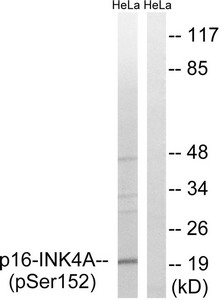
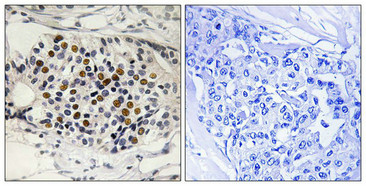
The antibody against CDKN2A was raised in rabbit using the Peptide sequence around phosphorylation site of serine 152 (G-P-S(p)-D-I) derived from Human p16-INK4a. as the immunogen. Antibodies were produced by immunizing rabbits with synthetic phosphopeptide and KLH conjugates. Antibodies were purified by affinity-chromatography using epitope-specific phosphopeptide. Non-phospho specific antibodies were removed by chromatogramphy usi This antibody has been validated on ELISA, WB, IHC.
$360.00
| Cat.No | ADC-40568A | Clonality | Polyclonal |
|---|---|---|---|
| Host Species | Rabbit | Target Name | CDKN2A |
| Form | Liquid | Species Reactivity | Human |
| Storage Buffer | PH 7.4, 0.02% sodium azide and 50% glycerol., 150mM NaCl, Rabbit IgG in phosphate buffered saline (without Mg2+ and Ca2+) | Application | ELISA, IHC, WB |
| Storage | Upon receipt |
| Immunogen Description | Peptide sequence around phosphorylation site of serine 152 (G-P-S(p)-D-I) derived from Human p16-INK4a. | Target Species | Human |
|---|---|---|---|
| Immunogen Sequence | Complete sequences for the immunogen, target protein, and peptides are available upon request. | Uniprot ID | P42771 |
Uniprot Id
P42771
Target Species
Human
Target Name
CDKN2A
Target Full Name
Cyclin-dependent kinase inhibitor 2A
Target Function
Acts as a negative regulator of the proliferation of normal cells by interacting strongly with CDK4 and CDK6. This inhibits their ability to interact with cyclins D and to phosphorylate the retinoblastoma protein.
Target Involvement
Melanoma, cutaneous malignant 2 (CMM2); Familial atypical multiple mole melanoma-pancreatic carcinoma syndrome (FAMMMPC); Melanoma-astrocytoma syndrome (MASTS)
Target Subcellular Location
Cytoplasm. Nucleus.
Target Protein Families
CDKN2 cyclin-dependent kinase inhibitor family
Target Tissue Specificity
Widely expressed but not detected in brain or skeletal muscle. Isoform 3 is pancreas-specific.
Target Synonyms
CDKN2A; CDKN2; MTS1; Cyclin-dependent kinase inhibitor 2A; Cyclin-dependent kinase 4 inhibitor A; CDK4I; Multiple tumor suppressor 1; MTS-1; p16-INK4a; p16-INK4; p16INK4A
Target Background
This gene generates several transcript variants which differ in their first exons. At least three alternatively spliced variants encoding distinct proteins have been reported, two of which encode structurally related isoforms known to function as inhibitors of CDK4 kinase. The remaining transcript includes an alternate first exon located 20 Kb upstream of the remainder of the gene; this transcript contains an alternate open reading frame (ARF) that specifies a protein which is structurally unrelated to the products of the other variants. This ARF product functions as a stabilizer of the tumor suppressor protein p53 as it can interact with, and sequester, the E3 ubiquitin-protein ligase MDM2, a protein responsible for the degradation of p53. In spite of the structural and functional differences, the CDK inhibitor isoforms and the ARF product encoded by this gene, through the regulatory roles of CDK4 and p53 in cell cycle G1 progression, share a common functionality in cell cycle G1 control. This gene is frequently mutated or deleted in a wide variety of tumors, and is known to be an important tumor suppressor gene.
Notification