-
Chinese (Simplified)
-
English
-
German
-
Korean
-
Spanish
Chinese (Simplified)
English
German
Korean
Spanish
Sign up for an account to enjoy easy online shopping and instant order tracking.
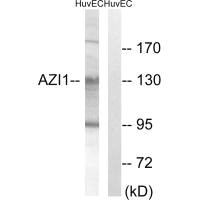
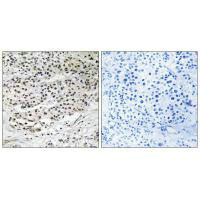
The antibody against CEP131 was raised in rabbit using the Synthesized peptide derived from internal of Human AZI1. as the immunogen. The antibody was affinity-purified from rabbit antiserum by affinity-chromatography using epitope-specific immunogen. This antibody has been validated on ELISA, WB, IHC.
$297.00
| Cat.No | ADC-41555A | Clonality | Polyclonal |
|---|---|---|---|
| Host Species | Rabbit | Target Name | CEP131 |
| Form | Liquid | Species Reactivity | Human, Mouse |
| Storage Buffer | PH 7.4, 0.02% sodium azide and 50% glycerol., 150mM NaCl, Rabbit IgG in phosphate buffered saline (without Mg2+ and Ca2+) | Purification Method | The antibody was affinity-purified from rabbit antiserum by affinity-chromatography using epitope-specific immunogen. |
| Application | ELISA, IHC, WB | Storage | Upon receipt |
| Immunogen Description | Synthesized peptide derived from internal of Human AZI1. | Target Species | Human |
|---|---|---|---|
| Immunogen Sequence | Complete sequences for the immunogen, target protein, and peptides are available upon request. | Uniprot ID | Q9UPN4 |
Uniprot Id
Q9UPN4
Target Species
Human
Target Name
CEP131
Target Full Name
Centrosomal protein of 131 kDa
Target Function
Component of centriolar satellites contributing to the building of a complex and dynamic network required to regulate cilia/flagellum formation. In proliferating cells, MIB1-mediated ubiquitination induces its sequestration within centriolar satellites, precluding untimely cilia formation initiation. In contrast, during normal and ultraviolet or heat shock cellular stress-induced ciliogenesis, its non-ubiquitinated form is rapidly displaced from centriolar satellites and recruited to centrosome/basal bodies in a microtubule- and p38 MAPK-dependent manner. Acts also as a negative regulator of BBSome ciliary trafficking. Plays a role in sperm flagellar formation; may be involved in the regulation of intraflagellar transport (IFT) and/or intramanchette (IMT) trafficking, which are important for axoneme extension and/or cargo delivery to the nascent sperm tail. Required for optimal cell proliferation and cell cycle progression; may play a role in the regulation of genome stability in non-ciliogenic cells. Involved in centriole duplication. Required for CEP152, WDR62 and CEP63 centrosomal localization and promotes the centrosomal localization of CDK2. Essential for maintaining proper centriolar satellite integrity.
Target Subcellular Location
Cytoplasm, cytoskeleton, microtubule organizing center, centrosome. Cytoplasm, cytoskeleton, microtubule organizing center, centrosome, centriolar satellite. Cytoplasm, cytoskeleton, microtubule organizing center, centrosome, centriole. Cytoplasm, cytoskeleton, cilium basal body. Cytoplasmic vesicle, secretory vesicle, acrosome.
Target Protein Families
CEP131 family
Target Synonyms
5 azacytidine induced 1; 5-azacytidine-induced protein 1; AZ1; Azi; Azi1; AZI1_HUMAN; Centrosomal protein 131 kDa; Centrosomal protein of 131 kDa; Cep131; KIAA1118; OTTMUSP00000004498; Pre-acrosome localization protein 1; RP23 37J21.1
Target Background
Enables protein homodimerization activity. Involved in several processes, including intraciliary transport involved in cilium assembly; protein localization to centrosome; and regulation of centrosome duplication. Located in several cellular components, including ciliary transition zone; intercellular bridge; and microtubule organizing center. Colocalizes with centrosome.
Notification