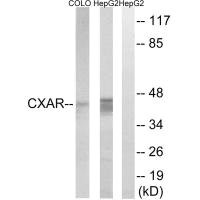
-
Chinese (Simplified)
-
English
-
German
-
Korean
-
Spanish
Chinese (Simplified)
English
German
Korean
Spanish
Sign up for an account to enjoy easy online shopping and instant order tracking.
The antibody against CXADR was raised in rabbit using the Synthesized peptide derived from internal of Human CXADR. as the immunogen. The antibody was affinity-purified from rabbit antiserum by affinity-chromatography using epitope-specific immunogen. This antibody has been validated on ELISA, WB.
$297.00
| Cat.No | ADC-41292A | Clonality | Polyclonal |
|---|---|---|---|
| Host Species | Rabbit | Target Name | CXADR |
| Target Synonyms | CXADR; CAR; Coxsackievirus and adenovirus receptor; hCAR; CVB3-binding protein; Coxsackievirus B-adenovirus receptor; HCVADR | Form | Liquid |
| Species Reactivity | Human | Storage Buffer | PH 7.4, 0.02% sodium azide and 50% glycerol., 150mM NaCl, Rabbit IgG in phosphate buffered saline (without Mg2+ and Ca2+) |
| Purification Method | The antibody was affinity-purified from rabbit antiserum by affinity-chromatography using epitope-specific immunogen. | Application | ELISA, WB |
| Storage | Upon receipt |
| Immunogen Description | Synthesized peptide derived from internal of Human CXADR. | Target Species | Human |
|---|---|---|---|
| Immunogen Sequence | Complete sequences for the immunogen, target protein, and peptides are available upon request. | Uniprot ID | P78310 |
Uniprot Id
P78310
Target Species
Human
Target Name
CXADR
Target Full Name
Coxsackievirus and adenovirus receptor
Target Function
Component of the epithelial apical junction complex that may function as a homophilic cell adhesion molecule and is essential for tight junction integrity. Also involved in transepithelial migration of leukocytes through adhesive interactions with JAML a transmembrane protein of the plasma membrane of leukocytes. The interaction between both receptors also mediates the activation of gamma-delta T-cells, a subpopulation of T-cells residing in epithelia and involved in tissue homeostasis and repair. Upon epithelial CXADR-binding, JAML induces downstream cell signaling events in gamma-delta T-cells through PI3-kinase and MAP kinases. It results in proliferation and production of cytokines and growth factors by T-cells that in turn stimulate epithelial tissues repair.; (Microbial infection) Acts as a receptor for adenovirus type C.; (Microbial infection) Acts as a receptor for Coxsackievirus B1 to B6.
Target Subcellular Location
[Isoform 1]: Cell membrane; Single-pass type I membrane protein. Basolateral cell membrane; Single-pass type I membrane protein. Cell junction, tight junction. Cell junction, adherens junction.; [Isoform 3]: Secreted.; [Isoform 4]: Secreted.; [Isoform 5]: Secreted.
Target Tissue Specificity
Expressed in pancreas, brain, heart, small intestine, testis, prostate and at a lower level in liver and lung. Isoform 5 is ubiquitously expressed. Isoform 3 is expressed in heart, lung and pancreas. In skeletal muscle, isoform 1 is found at the neuromusc
Target Synonyms
CXADR; CAR; Coxsackievirus and adenovirus receptor; hCAR; CVB3-binding protein; Coxsackievirus B-adenovirus receptor; HCVADR
Target Background
The protein encoded by this gene is a type I membrane receptor for group B coxsackieviruses and subgroup C adenoviruses. Several transcript variants encoding different isoforms have been found for this gene. Pseudogenes of this gene are found on chromosomes 15, 18, and 21.
Notification