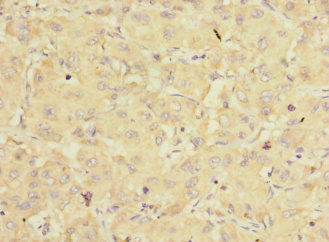
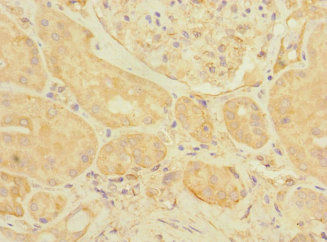
-
Chinese (Simplified)
-
English
-
German
-
Korean
-
Spanish
Chinese (Simplified)
English
German
Korean
Spanish
Sign up for an account to enjoy easy online shopping and instant order tracking.
The antibody against EIF3K was raised in rabbit using the Recombinant Human Eukaryotic translation initiation factor 3 subunit K protein (1-218AA) as the immunogen. This antibody exists as a non-conjugated isotype IgG, Antigen affinity purified. This antibody has been validated on ELISA, WB, IHC, IP.
$299.00
| Cat.No | ADC-16556A | Clonality | Polyclonal |
|---|---|---|---|
| Host Species | Rabbit | Target Name | EIF3K |
| Form | Liquid | Species Reactivity | Human |
| Isotype | IgG | Storage Buffer | 50% Glycerol, PBS with 0.02% sodium azide, pH7.3. |
| Purification Method | Antigen affinity purified | Conjugate | Non-conjugated |
| Application | ELISA, IHC, WB, IP | Storage | Upon receipt |
| Immunogen Description | Recombinant Human Eukaryotic translation initiation factor 3 subunit K protein (1-218AA) | Target Species | Human |
|---|---|---|---|
| Immunogen Sequence | Complete sequences for the immunogen, target protein, and peptides are available upon request. | Uniprot ID | Q9UBQ5 |
Uniprot Id
Q9UBQ5
Target Species
Human
Target Name
EIF3K
Target Full Name
Eukaryotic translation initiation factor 3 subunit K
Target Function
Component of the eukaryotic translation initiation factor 3 (eIF-3) complex, which is required for several steps in the initiation of protein synthesis. The eIF-3 complex associates with the 40S ribosome and facilitates the recruitment of eIF-1, eIF-1A, eIF-2:GTP:methionyl-tRNAi and eIF-5 to form the 43S pre-initiation complex (43S PIC). The eIF-3 complex stimulates mRNA recruitment to the 43S PIC and scanning of the mRNA for AUG recognition. The eIF-3 complex is also required for disassembly and recycling of post-termination ribosomal complexes and subsequently prevents premature joining of the 40S and 60S ribosomal subunits prior to initiation. The eIF-3 complex specifically targets and initiates translation of a subset of mRNAs involved in cell proliferation, including cell cycling, differentiation and apoptosis, and uses different modes of RNA stem-loop binding to exert either translational activation or repression.
Target Subcellular Location
Nucleus. Cytoplasm.
Target Protein Families
EIF-3 subunit K family
Target Tissue Specificity
Ubiquitous, with the highest levels of expression in brain, testis and kidney.
Target Synonyms
ARG134; eIF 3 p25; eIF 3 p28; eIF-3 p25; eIF-3 p28; EIF3-p28; eif3k; EIF3K_HUMAN; EIF3S12; Eukaryotic translation initiation factor 3 subunit 12; Eukaryotic translation initiation factor 3 subunit K; HSPC029; M9; MSTP001; Muscle specific gene M9 protein; Muscle-specific gene M9 protein; PLAC 24; PLAC-24; PLAC24; PRO1474; PTD001
Target Background
The 700-kD eukaryotic translation initiation factor-3 (eIF3) is the largest eIF and contains at least 12 subunits, including EIF2S12. eIF3 plays an essential role in translation by binding directly to the 40S ribosomal subunit and promoting formation of the 40S preinitiation complex (Mayeur et al., 2003 [PubMed 14519125]).
Notification