-
Chinese (Simplified)
-
English
-
German
-
Korean
-
Spanish
Chinese (Simplified)
English
German
Korean
Spanish
Sign up for an account to enjoy easy online shopping and instant order tracking.
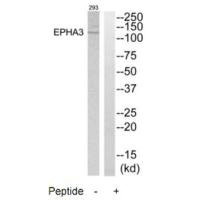
The antibody against EPHA3 was raised in rabbit using the Synthesized peptide derived from internal of Human EPHA3. as the immunogen. The antibody was affinity-purified from rabbit antiserum by affinity-chromatography using epitope-specific immunogen. This antibody has been validated on ELISA, WB.
$297.00
| Cat.No | ADC-42092A | Clonality | Polyclonal |
|---|---|---|---|
| Host Species | Rabbit | Target Name | EPHA3 |
| Form | Liquid | Species Reactivity | Human |
| Storage Buffer | PH 7.4, 0.02% sodium azide and 50% glycerol., 150mM NaCl, Rabbit IgG in phosphate buffered saline (without Mg2+ and Ca2+) | Purification Method | The antibody was affinity-purified from rabbit antiserum by affinity-chromatography using epitope-specific immunogen. |
| Application | ELISA, WB | Storage | Upon receipt |
| Immunogen Description | Synthesized peptide derived from internal of Human EPHA3. | Target Species | Human |
|---|---|---|---|
| Immunogen Sequence | Complete sequences for the immunogen, target protein, and peptides are available upon request. | Uniprot ID | P29320 |
Uniprot Id
P29320
Target Species
Human
Target Name
EPHA3
Target Full Name
Ephrin type-A receptor 3
Target Function
Receptor tyrosine kinase which binds promiscuously membrane-bound ephrin family ligands residing on adjacent cells, leading to contact-dependent bidirectional signaling into neighboring cells. The signaling pathway downstream of the receptor is referred to as forward signaling while the signaling pathway downstream of the ephrin ligand is referred to as reverse signaling. Highly promiscuous for ephrin-A ligands it binds preferentially EFNA5. Upon activation by EFNA5 regulates cell-cell adhesion, cytoskeletal organization and cell migration. Plays a role in cardiac cells migration and differentiation and regulates the formation of the atrioventricular canal and septum during development probably through activation by EFNA1. Involved in the retinotectal mapping of neurons. May also control the segregation but not the guidance of motor and sensory axons during neuromuscular circuit development.
Target Involvement
Colorectal cancer (CRC)
Target Subcellular Location
[Isoform 1]: Cell membrane; Single-pass type I membrane protein.; [Isoform 2]: Secreted.
Target Protein Families
Protein kinase superfamily, Tyr protein kinase family, Ephrin receptor subfamily
Target Tissue Specificity
Widely expressed. Highest level in placenta.
Target Synonyms
AW492086; Cek4; EC 2.7.10.1; EK4; End3; Eph receptor A3; EPH-like kinase 4; EPH-like tyrosine kinase 1; EPHA3; EPHA3_HUMAN; Ephrin receptor EphA3; Ephrin type-A receptor 3; ETK 1; ETK; ETK1; HEK 4; HEK; HEK4; Human embryo kinase 1; Human embryo kinase; Mek4; MGC109882; Receptor tyrosine kinase HEK; Testicular tissue protein Li 64; Tyro 4; Tyro4; TYRO4 protein tyrosine kinase; Tyrosine protein kinase receptor ETK 1; Tyrosine-protein kinase receptor ETK1; Tyrosine-protein kinase TYRO4
Target Background
This gene belongs to the ephrin receptor subfamily of the protein-tyrosine kinase family. EPH and EPH-related receptors have been implicated in mediating developmental events, particularly in the nervous system. Receptors in the EPH subfamily typically have a single kinase domain and an extracellular region containing a Cys-rich domain and 2 fibronectin type III repeats. The ephrin receptors are divided into 2 groups based on the similarity of their extracellular domain sequences and their affinities for binding ephrin-A and ephrin-B ligands. This gene encodes a protein that binds ephrin-A ligands. Two alternatively spliced transcript variants have been described for this gene.
Notification