-
Chinese (Simplified)
-
English
-
German
-
Korean
-
Spanish

Chinese (Simplified)
English
German
Korean
Spanish
Sign up for an account to enjoy easy online shopping and instant order tracking.
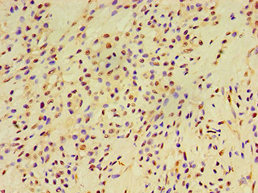
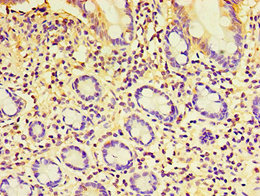
The antibody against EXOC2 was raised in rabbit using the Recombinant Human Exocyst complex component 2 protein (1-220AA) as the immunogen. This antibody exists as a non-conjugated isotype IgG, Antigen affinity purified. This antibody has been validated on ELISA, IHC.
$299.00
| Cat.No | ADC-40520A | Clonality | Polyclonal |
|---|---|---|---|
| Host Species | Rabbit | Target Name | EXOC2 |
| Form | Liquid | Species Reactivity | Human |
| Isotype | IgG | Storage Buffer | 50% Glycerol, PBS with 0.02% sodium azide, pH7.3. |
| Purification Method | Antigen affinity purified | Conjugate | Non-conjugated |
| Application | ELISA, IHC | Storage | Upon receipt |
| Immunogen Description | Recombinant Human Exocyst complex component 2 protein (1-220AA) | Target Species | Human |
|---|---|---|---|
| Immunogen Sequence | Complete sequences for the immunogen, target protein, and peptides are available upon request. | Uniprot ID | Q96KP1 |
Uniprot Id
Q96KP1
Target Species
Human
Target Name
EXOC2
Target Full Name
Exocyst complex component 2
Target Function
Component of the exocyst complex involved in the docking of exocytic vesicles with fusion sites on the plasma membrane.
Target Subcellular Location
Midbody, Midbody ring.
Target Protein Families
SEC5 family
Target Tissue Specificity
Widely expressed with highest levels in brain and placenta.
Target Synonyms
EXOC2; EXOC2_HUMAN; Exocyst complex component 2; Exocyst complex component Sec5; FLJ11026 ; SEC5; SEC5 like 1; SEC5L1; Sec5p
Target Background
The protein encoded by this gene is a component of the exocyst complex, a multi-protein complex essential for the polarized targeting of exocytic vesicles to specific docking sites on the plasma membrane. Though best characterized in yeast, the component proteins and the functions of the exocyst complex have been demonstrated to be highly conserved in higher eukaryotes. At least eight components of the exocyst complex, including this protein, are found to interact with the actin cytoskeletal remodeling and vesicle transport machinery. This interaction has been shown to mediate filopodia formation in fibroblasts. This protein has been shown to interact with the Ral subfamily of GTPases and thereby mediate exocytosis by tethering vesicles to the plasma membrane. Alternative splicing results in multiple transcript variants.
Notification