• Contact info@abtriva.com for inquiries and orders.
  • Chinese (Simplified)

  • English

  • German

  • Korean

  • Spanish

United States (English / $ USD)

Rabbit anti-Human FGF13 Polyclonal Antibody

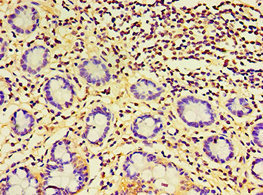
The antibody against FGF13 was raised in rabbit using the Recombinant Human Fibroblast growth factor 13 protein (1-245AA) as the immunogen. This antibody exists as a non-conjugated isotype IgG, Antigen affinity purified. This antibody has been validated on ELISA, WB, IHC.

ADC-40518A

The antibody against FGF13 was raised in rabbit using the Recombinant Human Fibroblast growth factor 13 protein (1-245AA) as the immunogen. This antibody exists as a non-conjugated isotype IgG, Antigen affinity purified. This antibody has been validated on ELISA, WB, IHC.

$299.00

Number
Order Exclusive Products Now

Request a Quote
High Purity LevelsPrecision and ReliabilityCustomization Options

Specifications


Cat.No ADC-40518A ClonalityPolyclonal
Host SpeciesRabbitTarget NameFGF13
FormLiquidSpecies ReactivityHuman, Rat
IsotypeIgGStorage Buffer50% Glycerol, PBS with 0.02% sodium azide, pH7.3.
Purification MethodAntigen affinity purifiedConjugateNon-conjugated
ApplicationELISA, IHC, WBStorageUpon receipt

Immunogen Information


Immunogen DescriptionRecombinant Human Fibroblast growth factor 13 protein (1-245AA)Target SpeciesHuman
Immunogen SequenceComplete sequences for the immunogen, target protein, and peptides are available upon request.Uniprot IDQ92913
Background Information
  • Uniprot Id

    Q92913

  • Target Species

    Human

  • Target Name

    FGF13

  • Target Full Name

    Fibroblast growth factor 13

  • Target Function

    Microtubule-binding protein which directly binds tubulin and is involved in both polymerization and stabilization of microtubules. Through its action on microtubules, may participate in the refinement of axons by negatively regulating axonal and leading processes branching. Plays a crucial role in neuron polarization and migration in the cerebral cortex and the hippocampus. May regulate voltage-gated sodium channels transport and function. May also play a role in MAPK signaling. Required for the development of axonal initial segment-targeting inhibitory GABAergic synapses made by chandelier neurons.

  • Target Subcellular Location

    Cell projection, filopodium. Cell projection, growth cone. Cell projection, dendrite. Nucleus. Cytoplasm.; [Isoform 1]: Nucleus, nucleolus.; [Isoform 2]: Cytoplasm. Nucleus.

  • Target Protein Families

    Heparin-binding growth factors family

  • Target Tissue Specificity

    Ubiquitously expressed. Predominantly expressed in the nervous system.

  • Target Research Area

    Signal Transduction

  • Target Synonyms

    FGF 13; FGF 2; FGF-13; FGF13; FGF13_HUMAN; FGF2; FHF 2; FHF-2; FHF2; Fibroblast growth factor 13; Fibroblast growth factor homologous factor 2; OTTHUMP00000024143; OTTHUMP00000024144

  • Target Background

    The protein encoded by this gene is a member of the fibroblast growth factor (FGF) family. FGF family members possess broad mitogenic and cell survival activities, and are involved in a variety of biological processes, including embryonic development, cell growth, morphogenesis, tissue repair, tumor growth, and invasion. This gene is located in a region on chromosome X, which is associated with Borjeson-Forssman-Lehmann syndrome (BFLS), making it a possible candidate gene for familial cases of the BFLS, and for other syndromal and nonspecific forms of X-linked cognitive disability mapping to this region. Alternative splicing of this gene at the 5' end results in several transcript variants encoding different isoforms with different N-termini.

Inquire Rabbit anti-Human FGF13 Polyclonal Antibody Now


AbTriva respects your privacy and protects your personal data in accordance with AbTriva. For more information, please see our data protection statement. *

Notification