• Contact info@abtriva.com for inquiries and orders.
  • Chinese (Simplified)

  • English

  • German

  • Korean

  • Spanish

United States (English / $ USD)

Rabbit anti-Human GDF9 Polyclonal Antibody

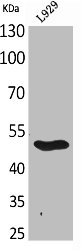
The antibody against GDF9 was raised in rabbit using the Synthesized peptide derived from the C-terminal region of Human GDF-9. as the immunogen. This antibody exists as a non-conjugated isotype IgG. The antibody was affinity-purified from rabbit antiserum by affinity-chromatography using epitope-specific immunogen. This antibody has been validated on WB, ELISA.

ADC-37052A

The antibody against GDF9 was raised in rabbit using the Synthesized peptide derived from the C-terminal region of Human GDF-9. as the immunogen. This antibody exists as a non-conjugated isotype IgG. The antibody was affinity-purified from rabbit antiserum by affinity-chromatography using epitope-specific immunogen. This antibody has been validated on WB, ELISA.

$167.00

Number
Order Exclusive Products Now

Request a Quote
High Purity LevelsPrecision and ReliabilityCustomization Options

Specifications


Cat.No ADC-37052A ClonalityPolyclonal
Host SpeciesRabbitTarget NameGDF9
Target SynonymsGDF9Growth/differentiation factor 9 antibody; GDF-9 antibodyFormLiquid
Species ReactivityHuman, Mouse, RatIsotypeIgG
Storage Buffer0.5% BSA and 0.02% sodium azide., Liquid in PBS containing 50% glycerolPurification MethodThe antibody was affinity-purified from rabbit antiserum by affinity-chromatography using epitope-specific immunogen.
ConjugateNon-conjugatedApplicationELISA, WB
StorageUpon receipt

Immunogen Information


Immunogen DescriptionSynthesized peptide derived from the C-terminal region of Human GDF-9.Target SpeciesHuman
Immunogen SequenceComplete sequences for the immunogen, target protein, and peptides are available upon request.Uniprot IDO60383
Background Information
  • Uniprot Id

    O60383

  • Target Species

    Human

  • Target Name

    GDF9

  • Target Full Name

    Growth/differentiation factor 9

  • Target Function

    Required for ovarian folliculogenesis. Promotes primordial follicle development. Stimulates granulosa cell proliferation. Promotes cell transition from G0/G1 to S and G2/M phases, through an increase of CCND1 and CCNE1 expression, and RB1 phosphorylation. It regulates STAR expression and cAMP-dependent progesterone release in granulosa and thecal cells. Attenuates the suppressive effects of activin A on STAR expression and progesterone production by increasing the expression of inhibin B. It suppresses FST and FSTL3 production in granulosa-lutein cells.

  • Target Involvement

    Altered GDF9 function may be involved in ovarian disorders. Rare variants in GDF9 have been found in patients with premature ovarian failure and mothers of dizygotic twins.

  • Target Subcellular Location

    Secreted.

  • Target Protein Families

    TGF-beta family

  • Target Tissue Specificity

    Expressed in ovarian granulosa cells. Present in oocytes of primary follicles (at protein level).

  • Target Research Area

    Cardiovascular

  • Target Synonyms

    GDF9Growth/differentiation factor 9; GDF-9

  • Target Background

    This gene encodes a secreted ligand of the TGF-beta (transforming growth factor-beta) superfamily of proteins. Ligands of this family bind various TGF-beta receptors leading to recruitment and activation of SMAD family transcription factors that regulate gene expression. The encoded preproprotein is proteolytically processed to generate each subunit of the disulfide-linked homodimer. This protein regulates ovarian function. Reduced expression of this gene may be associated with polycystic ovary syndrome and mutations in this gene may be more common in mothers of dizygotic twins.

Inquire Rabbit anti-Human GDF9 Polyclonal Antibody Now


AbTriva respects your privacy and protects your personal data in accordance with AbTriva. For more information, please see our data protection statement. *

Notification