-
Chinese (Simplified)
-
English
-
German
-
Korean
-
Spanish
Chinese (Simplified)
English
German
Korean
Spanish
Sign up for an account to enjoy easy online shopping and instant order tracking.
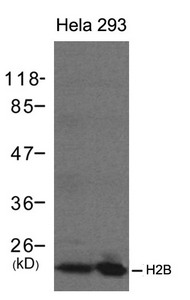
The antibody against HIST1H2BB was raised in rabbit using the Peptide sequence around aa.41~45 (Y-V-Y-K-V) derived from Human H2B. as the immunogen. Antibodies were produced by immunizing rabbits with synthetic peptide and KLH conjugates. Antibodies were purified by affinity-chromatography using epitope-specific peptide. This antibody has been validated on ELISA, WB.
$297.00
| Cat.No | ADC-43113A | Clonality | Polyclonal |
|---|---|---|---|
| Host Species | Rabbit | Target Name | HIST1H2BB |
| Target Synonyms | HIST1H2BB antibody; H2BFFHistone H2B type 1-B antibody; Histone H2B.1 antibody; Histone H2B.f antibody; H2B/f antibody | Form | Liquid |
| Species Reactivity | Human, Mouse, Rat | Storage Buffer | PH 7.4, 0.02% sodium azide and 50% glycerol., 150mM NaCl, Supplied at 1.0mg/mL in phosphate buffered saline (without Mg2+ and Ca2+) |
| Purification Method | Antibodies were produced by immunizing rabbits with synthetic peptide and KLH conjugates. Antibodies were purified by affinity-chromatography using epitope-specific peptide. | Application | ELISA, WB |
| Storage | Upon receipt |
| Immunogen Description | Peptide sequence around aa.41~45 (Y-V-Y-K-V) derived from Human H2B. | Target Species | Human |
|---|---|---|---|
| Immunogen Sequence | Complete sequences for the immunogen, target protein, and peptides are available upon request. | Uniprot ID | P33778 |
Uniprot Id
P33778
Target Species
Human
Target Name
H2BC3
Target Full Name
Histone H2B type 1-B
Target Function
Core component of nucleosome. Nucleosomes wrap and compact DNA into chromatin, limiting DNA accessibility to the cellular machineries which require DNA as a template. Histones thereby play a central role in transcription regulation, DNA repair, DNA replication and chromosomal stability. DNA accessibility is regulated via a complex set of post-translational modifications of histones, also called histone code, and nucleosome remodeling.
Target Subcellular Location
Nucleus. Chromosome.
Target Protein Families
Histone H2B family
Target Research Area
Epigenetics and Nuclear Signaling
Target Synonyms
HIST1H2BB; H2BFFHistone H2B type 1-B; Histone H2B.1; Histone H2B.f; H2B/f
Target Background
Histones are basic nuclear proteins that are responsible for the nucleosome structure of the chromosomal fiber in eukaryotes. Nucleosomes consist of approximately 146 bp of DNA wrapped around a histone octamer composed of pairs of each of the four core histones (H2A, H2B, H3, and H4). The chromatin fiber is further compacted through the interaction of a linker histone, H1, with the DNA between the nucleosomes to form higher order chromatin structures. This gene is intronless and encodes a replication-dependent histone that is a member of the histone H2B family. Transcripts from this gene lack polyA tails; instead, they contain a palindromic termination element. This gene is found in the large histone gene cluster on chromosome 6p22-p21.3.
Notification