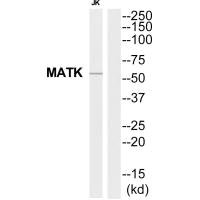
-
Chinese (Simplified)
-
English
-
German
-
Korean
-
Spanish
Chinese (Simplified)
English
German
Korean
Spanish
Sign up for an account to enjoy easy online shopping and instant order tracking.
The antibody against MATK was raised in rabbit using the Synthesized peptide derived from Internal of Human MATK. as the immunogen. The antibody was affinity-purified from rabbit antiserum by affinity-chromatography using epitope-specific immunogen. This antibody has been validated on ELISA, WB.
$297.00
| Cat.No | ADC-40701A | Clonality | Polyclonal |
|---|---|---|---|
| Host Species | Rabbit | Target Name | MATK |
| Form | Liquid | Species Reactivity | Human, Mouse, Rat |
| Storage Buffer | PH 7.4, 0.02% sodium azide and 50% glycerol., 150mM NaCl, Rabbit IgG in phosphate buffered saline (without Mg2+ and Ca2+) | Purification Method | The antibody was affinity-purified from rabbit antiserum by affinity-chromatography using epitope-specific immunogen. |
| Application | ELISA, WB | Storage | Upon receipt |
| Immunogen Description | Synthesized peptide derived from Internal of Human MATK. | Target Species | Human |
|---|---|---|---|
| Immunogen Sequence | Complete sequences for the immunogen, target protein, and peptides are available upon request. | Uniprot ID | P42679 |
Uniprot Id
P42679
Target Species
Human
Target Name
MATK
Target Full Name
Megakaryocyte-associated tyrosine-protein kinase
Target Function
Could play a significant role in the signal transduction of hematopoietic cells. May regulate tyrosine kinase activity of SRC-family members in brain by specifically phosphorylating their C-terminal regulatory tyrosine residue which acts as a negative regulatory site. It may play an inhibitory role in the control of T-cell proliferation.
Target Subcellular Location
Cytoplasm. Membrane. Note=In platelets, 90% of MATK localizes to the membrane fraction, and translocates to the cytoskeleton upon thrombin stimulation.
Target Protein Families
Protein kinase superfamily, Tyr protein kinase family, CSK subfamily
Target Tissue Specificity
Expressed in various myeloid cell lines, detected in brain and lung.
Target Synonyms
CHK ; Csk homologous kinase; Csk type protein tyrosine kinase; CTK ; DKFZp434N1212 ; EC 2.7.10.2; Hematopoietic consensus tyrosine lacking kinase; Hematopoietic consensus tyrosine-lacking kinase; HHYLTK ; Hydroxyaryl protein kinase ; HYL ; HYL tyrosine kinase; HYLTK ; Leukocyte carboxyl terminal src kinase related; Lsk ; matK; MATK_HUMAN; Megakaryocyte associated tyrosine kinase; Megakaryocyte associated tyrosine protein kinase; Megakaryocyte-associated tyrosine-protein kinase; MGC1708 ; MGC2101 ; Protein kinase HYL; Tyrosine kinase MATK; Tyrosine protein kinase CTK; Tyrosine-protein kinase CTK; Tyrosylprotein kinase
Target Background
The protein encoded by this gene has amino acid sequence similarity to Csk tyrosine kinase and has the structural features of the CSK subfamily: SRC homology SH2 and SH3 domains, a catalytic domain, a unique N terminus, lack of myristylation signals, lack of a negative regulatory phosphorylation site, and lack of an autophosphorylation site. This protein is thought to play a significant role in the signal transduction of hematopoietic cells. It is able to phosphorylate and inactivate Src family kinases, and may play an inhibitory role in the control of T-cell proliferation. This protein might be involved in signaling in some cases of breast cancer. Three alternatively spliced transcript variants that encode different isoforms have been described for this gene.
Notification