-
Chinese (Simplified)
-
English
-
German
-
Korean
-
Spanish
Chinese (Simplified)
English
German
Korean
Spanish
Sign up for an account to enjoy easy online shopping and instant order tracking.
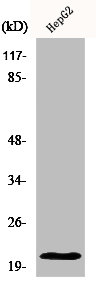
The antibody against MRPL41 was raised in rabbit using the Synthesized peptide derived from the Internal region of Human MRP-L41. as the immunogen. This antibody exists as a non-conjugated isotype IgG. The antibody was affinity-purified from rabbit antiserum by affinity-chromatography using epitope-specific immunogen. This antibody has been validated on WB, IHC, ELISA.
$167.00
| Cat.No | ADC-38194A | Clonality | Polyclonal |
|---|---|---|---|
| Host Species | Rabbit | Target Name | MRPL41 |
| Form | Liquid | Species Reactivity | Human, Mouse, Rat |
| Isotype | IgG | Storage Buffer | 0.5% BSA and 0.02% sodium azide., Liquid in PBS containing 50% glycerol |
| Purification Method | The antibody was affinity-purified from rabbit antiserum by affinity-chromatography using epitope-specific immunogen. | Conjugate | Non-conjugated |
| Application | ELISA, IHC, WB | Storage | Upon receipt |
| Immunogen Description | Synthesized peptide derived from the Internal region of Human MRP-L41. | Target Species | Human |
|---|---|---|---|
| Immunogen Sequence | Complete sequences for the immunogen, target protein, and peptides are available upon request. | Uniprot ID | Q8IXM3 |
Uniprot Id
Q8IXM3
Target Species
Human
Target Name
MRPL41
Target Full Name
Large ribosomal subunit protein mL41
Target Function
Component of the mitochondrial ribosome large subunit. Also involved in apoptosis and cell cycle. Enhances p53/TP53 stability, thereby contributing to p53/TP53-induced apoptosis in response to growth-inhibitory condition. Enhances p53/TP53 translocation to the mitochondria. Has the ability to arrest the cell cycle at the G1 phase, possibly by stabilizing the CDKN1A and CDKN1B (p27Kip1) proteins.
Target Subcellular Location
Mitochondrion.
Target Protein Families
Mitochondrion-specific ribosomal protein mL41 family
Target Tissue Specificity
Present in kidney, liver, thymus and testis, and at lower level in brain and spleen (at protein level).
Target Synonyms
39S ribosomal protein L27 homolog; 39S ribosomal protein L41; 39S ribosomal protein L41 mitochondrial; Bcl-2-interacting mitochondrial ribosomal protein L41; BMRP; Cell proliferation-inducing gene 3 protein; L41mt; mitochondrial; Mitochondrial ribosomal protein L41; MRP L27; MRP-L27 homolog; MRP-L41; MRPL27; mRpL41; PIG3; Proliferation inducing gene 3; RM41_HUMAN; RPML27
Target Background
Mammalian mitochondrial ribosomal proteins are encoded by nuclear genes and help in protein synthesis within the mitochondrion. Mitochondrial ribosomes (mitoribosomes) consist of a small 28S subunit and a large 39S subunit. They have an estimated 75% protein to rRNA composition compared to prokaryotic ribosomes, where this ratio is reversed. Another difference between mammalian mitoribosomes and prokaryotic ribosomes is that the latter contain a 5S rRNA. Among different species, the proteins comprising the mitoribosome differ greatly in sequence, and sometimes in biochemical properties, which prevents easy recognition by sequence homology. This gene encodes a 39S subunit protein that belongs to the YmL27 ribosomal protein family.
Notification