-
Chinese (Simplified)
-
English
-
German
-
Korean
-
Spanish

Chinese (Simplified)
English
German
Korean
Spanish
Sign up for an account to enjoy easy online shopping and instant order tracking.
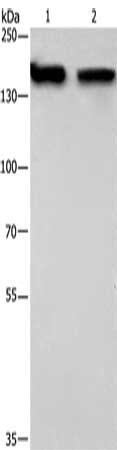
The antibody against NCAPD2 was raised in rabbit using the Fusion protein of Human NCAPD2 as the immunogen. This antibody exists as a non-conjugated isotype IgG, Antigen affinity purified. This antibody has been validated on ELISA, WB, IHC.
$299.00
| Cat.No | ADC-30455A | Clonality | Polyclonal |
|---|---|---|---|
| Host Species | Rabbit | Target Name | NCAPD2 |
| Form | Liquid | Species Reactivity | Human, Mouse |
| Isotype | IgG | Storage Buffer | 0.05% NaN3, 40% Glycerol., pH7.4 PBS |
| Purification Method | Antigen affinity purified | Conjugate | Non-conjugated |
| Application | ELISA, IHC, WB | Storage | Upon receipt |
| Immunogen Description | Fusion protein of Human NCAPD2 | Target Species | Human |
|---|---|---|---|
| Immunogen Sequence | Complete sequences for the immunogen, target protein, and peptides are available upon request. | Uniprot ID | Q15021 |
Uniprot Id
Q15021
Target Species
Human
Target Name
NCAPD2
Target Full Name
Condensin complex subunit 1
Target Function
Regulatory subunit of the condensin complex, a complex required for conversion of interphase chromatin into mitotic-like condense chromosomes. The condensin complex probably introduces positive supercoils into relaxed DNA in the presence of type I topoisomerases and converts nicked DNA into positive knotted forms in the presence of type II topoisomerases. May target the condensin complex to DNA via its C-terminal domain. May promote the resolution of double-strand DNA catenanes (intertwines) between sister chromatids. Condensin-mediated compaction likely increases tension in catenated sister chromatids, providing directionality for type II topoisomerase-mediated strand exchanges toward chromatid decatenation. Required for decatenation of non-centromeric ultrafine DNA bridges during anaphase. Early in neurogenesis, may play an essential role to ensure accurate mitotic chromosome condensation in neuron stem cells, ultimately affecting neuron pool and cortex size.
Target Subcellular Location
Nucleus. Cytoplasm. Chromosome. Note=In interphase cells, the majority of the condensin complex is found in the cytoplasm, while a minority of the complex is associated with chromatin. A subpopulation of the complex however remains associated with chromosome foci in interphase cells. During mitosis, most of the condensin complex is associated with the chromatin. At the onset of prophase, the regulatory subunits of the complex are phosphorylated by CDK1, leading to condensin's association with chromosome arms and to chromosome condensation. Dissociation from chromosomes is observed in late telophase.
Target Protein Families
CND1 (condensin subunit 1) family
Target Synonyms
NCAPD2; CAPD2; CNAP1; KIAA0159Condensin complex subunit 1; Chromosome condensation-related SMC-associated protein 1; Chromosome-associated protein D2; hCAP-D2; Non-SMC condensin I complex subunit D2; XCAP-D2 homolog
Target Background
Enables histone binding activity. Involved in mitotic chromosome condensation. Located in condensed chromosome; cytosol; and nucleoplasm. Part of condensin complex. Colocalizes with cytoplasm and nuclear chromosome. Implicated in primary autosomal recessive microcephaly.
Notification