• Contact info@abtriva.com for inquiries and orders.
  • Chinese (Simplified)

  • English

  • German

  • Korean

  • Spanish

United States (English / $ USD)

Rabbit anti-Human NLRX1 Polyclonal Antibody

The antibody against NLRX1 was raised in Rabbit using the recombinant fusion protein containing a sequence corresponding to amino acids 87-360 of human NLRX1 (NP_078894.2) as the immunogen. The polyclonal antibody exists as a isotype IgG, by affinity purification. This antibody has been validated on WB, IP, ELISA.

ADA-08628A

The antibody against NLRX1 was raised in Rabbit using the recombinant fusion protein containing a sequence corresponding to amino acids 87-360 of human NLRX1 (NP_078894.2) as the immunogen. The polyclonal antibody exists as a isotype IgG, by affinity purification. This antibody has been validated on WB, IP, ELISA.

Number
Order Exclusive Products Now

Request a Quote
High Purity LevelsPrecision and ReliabilityCustomization Options

Specifications


Cat.No ADA-08628A ClonalityPolyclonal
Host SpeciesRabbitTarget NameNLRX1
Target SynonymsNOD5; NOD9; NOD26; DLNB26; CLR11.3; NLRX1FormLiquid
Species ReactivityHuman, Mouse, RatIsotypeIgG
Storage Buffer50% Glycerol, PBS with 0.01% thimerosal, pH7.3.Purification MethodAffinity purification
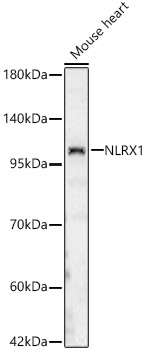
Positive SamplesMouse heartApplicationELISA, WB, IP

Immunogen Information


Immunogen DescriptionRecombinant fusion protein containing a sequence corresponding to amino acids 87-360 of human NLRX1 (NP_078894.2).Target SpeciesHuman
Uniprot IDQ86UT6Immunogen Sequence
Background Information
  • Uniprot Id

    Q86UT6

  • Target Species

    Human

  • Target Name

    NLRX1

  • Target Full Name

    NLR family member X1

  • Target Function

    Participates in antiviral signaling. Acts as a negative regulator of MAVS-mediated antiviral responses, through the inhibition of the virus-induced RLH (RIG-like helicase)-MAVS interaction. Instead, promotes autophagy by interacting with TUFM and subsequently recruiting the autophagy-related proteins ATG5 and ATG12. Regulates also MAVS-dependent NLRP3 inflammasome activation to attenuate apoptosis. Has no inhibitory function on NF-kappa-B signaling pathway, but enhances NF-kappa-B and JUN N-terminal kinase dependent signaling through the production of reactive oxygen species.

  • Target Subcellular Location

    Mitochondrion outer membrane.

  • Target Protein Families

    NLRP family

  • Target Tissue Specificity

    Ubiquitously expressed. Strongest expression in mammary gland, heart and muscle. Detected in HeLa, HEK293T, THP-1, HL-60, Raji and Jurkat cell lines (at protein level).

  • Target Synonyms

    Caterpiller protein 11.3; CLR11.3; DLNB26; FLJ21478; MGC131937; MGC21025; NLR family member X1; NLR family, X1; Nlrx1; NLRX1_HUMAN; NOD-like receptor X1; NOD26; NOD5; NOD9; Nucleotide-binding oligomerization domain protein 26; Nucleotide-binding oligomerization domain protein 5; Nucleotide-binding oligomerization domain protein 9; nucleotide-binding oligomerization domain, leucine rich repeat containing X1; Protein Caterpiller 11.3

  • Target Background

    The protein encoded by this gene is a member of the NLR family and localizes to the outer mitochondrial membrane. The encoded protein is a regulator of mitochondrial antivirus responses. Three transcript variants encoding the same protein have been found for this gene.

Inquire Rabbit anti-Human NLRX1 Polyclonal Antibody Now


AbTriva respects your privacy and protects your personal data in accordance with AbTriva. For more information, please see our data protection statement. *

Notification