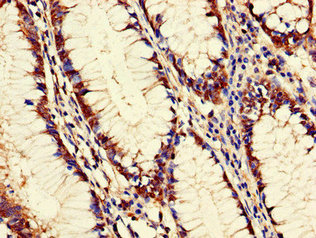
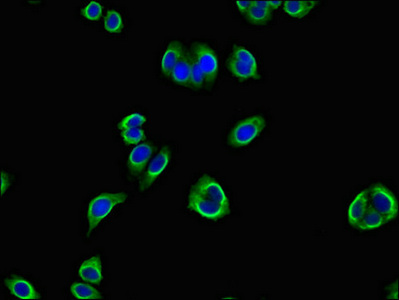
-
Chinese (Simplified)
-
English
-
German
-
Korean
-
Spanish
Chinese (Simplified)
English
German
Korean
Spanish
Sign up for an account to enjoy easy online shopping and instant order tracking.
The antibody against PANK2 was raised in rabbit using the Recombinant Human Pantothenate kinase 2, mitochondrial protein (437-490AA) as the immunogen. This antibody exists as a non-conjugated isotype IgG, purified by protein G with a purity greater than 95%. This antibody has been validated on ELISA, WB, IHC, IF.
$299.00
| Cat.No | ADC-13691A | Clonality | Polyclonal |
|---|---|---|---|
| Host Species | Rabbit | Target Name | PANK2 |
| Form | Liquid | Species Reactivity | Human, Mouse |
| Isotype | IgG | Storage Buffer | 0.01M PBS, 0.03% Proclin 300; Constituents: 50% Glycerol, PH 7.4 |
| Purification Method | >95%, Protein G purified | Conjugate | Non-conjugated |
| Application | ELISA, IF, IHC, WB | Storage | Upon receipt |
| Immunogen Description | Recombinant Human Pantothenate kinase 2, mitochondrial protein (437-490AA) | Target Species | Human |
|---|---|---|---|
| Immunogen Sequence | Complete sequences for the immunogen, target protein, and peptides are available upon request. | Uniprot ID | Q9BZ23 |
Uniprot Id
Q9BZ23
Target Species
Human
Target Name
PANK2
Target Full Name
Pantothenate kinase 2, mitochondrial
Target Function
Catalyzes the phosphorylation of pantothenate to generate 4'-phosphopantothenate in the first and rate-determining step of coenzyme A (CoA) synthesis. Required for angiogenic activity of umbilical vein of endothelial cells (HUVEC).; Catalyzes the phosphorylation of pantothenate to generate 4'-phosphopantothenate in the first and rate-determining step of coenzyme A (CoA) synthesis.
Target Involvement
Neurodegeneration with brain iron accumulation 1 (NBIA1); Hypoprebetalipoproteinemia, acanthocytosis, retinitis pigmentosa, and pallidal degeneration (HARP)
Target Subcellular Location
[Isoform 1]: Mitochondrion. Mitochondrion intermembrane space. Nucleus.; [Isoform 2]: Cytoplasm.; [Isoform 3]: Cytoplasm.; [Isoform 4]: Cytoplasm.
Target Protein Families
Type II pantothenate kinase family
Target Tissue Specificity
Expressed in the brain (at protein level). Ubiquitous. Highly expressed in the testis. Expressed in the umbilical vein endothelial cells (HUVEC).
Target Synonyms
4933409I19Rik; AI642621; C20orf48; Hallervorden Spatz syndrome; HARP; hPANK2; HSS; MGC118448; MGC15053; mitochondrial; NBIA1; PANK2; PANK2_HUMAN; Pantothenate kinase 2 (Hallervorden Spatz syndrome); Pantothenate kinase 2; Pantothenate kinase 2 mitochondrial; Pantothenic acid kinase 2; PKAN; RP23 387C21.4
Target Background
This gene encodes a protein belonging to the pantothenate kinase family and is the only member of that family to be expressed in mitochondria. Pantothenate kinase is a key regulatory enzyme in the biosynthesis of coenzyme A (CoA) in bacteria and mammalian cells. It catalyzes the first committed step in the universal biosynthetic pathway leading to CoA and is itself subject to regulation through feedback inhibition by acyl CoA species. Mutations in this gene are associated with HARP syndrome and pantothenate kinase-associated neurodegeneration (PKAN), formerly Hallervorden-Spatz syndrome. Alternative splicing, involving the use of alternate first exons, results in multiple transcripts encoding different isoforms.
Notification