-
Chinese (Simplified)
-
English
-
German
-
Korean
-
Spanish

Chinese (Simplified)
English
German
Korean
Spanish
Sign up for an account to enjoy easy online shopping and instant order tracking.
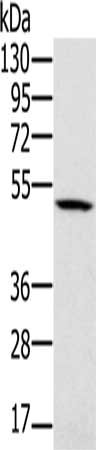
The antibody against PSMC2 was raised in rabbit using the Fusion protein of Human PSMC2 as the immunogen. This antibody exists as a non-conjugated isotype IgG, Antigen affinity purified. This antibody has been validated on ELISA, WB, IHC.
$299.00
| Cat.No | ADC-29669A | Clonality | Polyclonal |
|---|---|---|---|
| Host Species | Rabbit | Target Name | PSMC2 |
| Form | Liquid | Species Reactivity | Human, Mouse, Rat |
| Isotype | IgG | Storage Buffer | 0.05% NaN3, 40% Glycerol., pH7.4 PBS |
| Purification Method | Antigen affinity purified | Conjugate | Non-conjugated |
| Application | ELISA, IHC, WB | Storage | Upon receipt |
| Immunogen Description | Fusion protein of Human PSMC2 | Target Species | Human |
|---|---|---|---|
| Immunogen Sequence | Complete sequences for the immunogen, target protein, and peptides are available upon request. | Uniprot ID | P35998 |
Uniprot Id
P35998
Target Species
Human
Target Name
PSMC2
Target Full Name
26S proteasome regulatory subunit 7
Target Function
Component of the 26S proteasome, a multiprotein complex involved in the ATP-dependent degradation of ubiquitinated proteins. This complex plays a key role in the maintenance of protein homeostasis by removing misfolded or damaged proteins, which could impair cellular functions, and by removing proteins whose functions are no longer required. Therefore, the proteasome participates in numerous cellular processes, including cell cycle progression, apoptosis, or DNA damage repair. PSMC2 belongs to the heterohexameric ring of AAA (ATPases associated with diverse cellular activities) proteins that unfolds ubiquitinated target proteins that are concurrently translocated into a proteolytic chamber and degraded into peptides.
Target Subcellular Location
Cytoplasm.
Target Protein Families
AAA ATPase family
Target Synonyms
26S protease complex; 26S protease regulatory subunit 7; 26S proteasome AAA-ATPase subunit RPT1; mammalian suppressor of sgv-1 of yeast; MSS1; Nbla10058; protease 26S subunit 7; Proteasome 19S S7; proteasome 26S ATPase subunit 2; Proteasome 26S subunit ATPase 2; Proteasome 26S subunit ATPase 2; Protein MSS1; PRS7_HUMAN; PSMC2; putative protein product of Nbla10058; S7
Target Background
The 26S proteasome is a multicatalytic proteinase complex with a highly ordered structure composed of 2 complexes, a 20S core and a 19S regulator. The 20S core is composed of 4 rings of 28 non-identical subunits; 2 rings are composed of 7 alpha subunits and 2 rings are composed of 7 beta subunits. The 19S regulator is composed of a base, which contains 6 ATPase subunits and 2 non-ATPase subunits, and a lid, which contains up to 10 non-ATPase subunits. Proteasomes are distributed throughout eukaryotic cells at a high concentration and cleave peptides in an ATP/ubiquitin-dependent process in a non-lysosomal pathway. An essential function of a modified proteasome, the immunoproteasome, is the processing of class I MHC peptides. This gene encodes one of the ATPase subunits, a member of the triple-A family of ATPases which have a chaperone-like activity. This subunit has been shown to interact with several of the basal transcription factors so, in addition to participation in proteasome functions, this subunit may participate in the regulation of transcription. This subunit may also compete with PSMC3 for binding to the HIV tat protein to regulate the interaction between the viral protein and the transcription complex. Alternative splicing results in multiple transcript variants encoding distinct isoforms.
Notification