-
Chinese (Simplified)
-
English
-
German
-
Korean
-
Spanish
Chinese (Simplified)
English
German
Korean
Spanish
Sign up for an account to enjoy easy online shopping and instant order tracking.
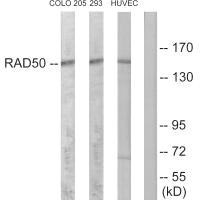
The antibody against RAD50 was raised in rabbit using the Synthesized peptide derived from internal of Human RAD50. as the immunogen. The antibody was affinity-purified from rabbit antiserum by affinity-chromatography using epitope-specific immunogen. This antibody has been validated on ELISA, WB.
$297.00
| Cat.No | ADC-41595A | Clonality | Polyclonal |
|---|---|---|---|
| Host Species | Rabbit | Target Name | RAD50 |
| Target Synonyms | homolog of antibody; RAD50_HUMAN antibody; RAD502 antibody; Rad50l antibody; Truncated RAD50 protein antibody, S. cerevisiae | Form | Liquid |
| Species Reactivity | Human, Mouse, Rat | Storage Buffer | PH 7.4, 0.02% sodium azide and 50% glycerol., 150mM NaCl, Rabbit IgG in phosphate buffered saline (without Mg2+ and Ca2+) |
| Purification Method | The antibody was affinity-purified from rabbit antiserum by affinity-chromatography using epitope-specific immunogen. | Application | ELISA, WB |
| Storage | Upon receipt |
| Immunogen Description | Synthesized peptide derived from internal of Human RAD50. | Target Species | Human |
|---|---|---|---|
| Immunogen Sequence | Complete sequences for the immunogen, target protein, and peptides are available upon request. | Uniprot ID | Q92878 |
Uniprot Id
Q92878
Target Species
Human
Target Name
RAD50
Target Full Name
DNA repair protein RAD50
Target Function
Component of the MRN complex, which plays a central role in double-strand break (DSB) repair, DNA recombination, maintenance of telomere integrity and meiosis. The complex possesses single-strand endonuclease activity and double-strand-specific 3'-5' exonuclease activity, which are provided by MRE11. RAD50 may be required to bind DNA ends and hold them in close proximity. This could facilitate searches for short or long regions of sequence homology in the recombining DNA templates, and may also stimulate the activity of DNA ligases and/or restrict the nuclease activity of MRE11 to prevent nucleolytic degradation past a given point. The complex may also be required for DNA damage signaling via activation of the ATM kinase. In telomeres the MRN complex may modulate t-loop formation.
Target Involvement
Nijmegen breakage syndrome-like disorder (NBSLD)
Target Subcellular Location
Nucleus. Chromosome, telomere. Chromosome.
Target Protein Families
SMC family, RAD50 subfamily
Target Tissue Specificity
Expressed at very low level in most tissues, except in testis where it is expressed at higher level. Expressed in fibroblasts.
Target Research Area
Epigenetics and Nuclear Signaling
Target Synonyms
DNA repair protein RAD50; hRAD50; hsRAD50; Mrell; NBSLD; Rad 50; RAD50 2; rad50; RAD50 homolog (S cerevisiae); RAD50 homolog; RAD50 PEN; RAD50, S. cerevisiae, homolog of; RAD50_HUMAN; RAD502; Rad50l; Truncated RAD50 protein
Target Background
The protein encoded by this gene is highly similar to Saccharomyces cerevisiae Rad50, a protein involved in DNA double-strand break repair. This protein forms a complex with MRE11 and NBS1. The protein complex binds to DNA and displays numerous enzymatic activities that are required for nonhomologous joining of DNA ends. This protein, cooperating with its partners, is important for DNA double-strand break repair, cell cycle checkpoint activation, telomere maintenance, and meiotic recombination. Knockout studies of the mouse homolog suggest this gene is essential for cell growth and viability. Mutations in this gene are the cause of Nijmegen breakage syndrome-like disorder.
Notification