-
Chinese (Simplified)
-
English
-
German
-
Korean
-
Spanish
Chinese (Simplified)
English
German
Korean
Spanish
Sign up for an account to enjoy easy online shopping and instant order tracking.
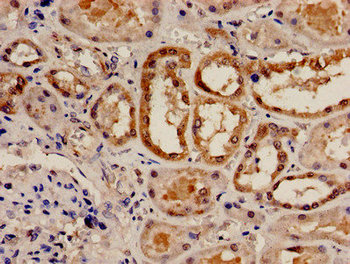
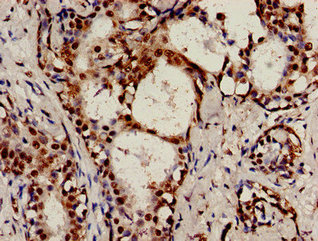
The antibody against RAD9A was raised in rabbit using the Recombinant Human Cell cycle checkpoint control protein RAD9A protein (267-341AA) as the immunogen. This antibody exists as a non-conjugated isotype IgG, purified by protein G with a purity greater than 95%. This antibody has been validated on ELISA, IHC.
$299.00
| Cat.No | ADC-09021A | Clonality | Polyclonal |
|---|---|---|---|
| Host Species | Rabbit | Target Name | RAD9A |
| Form | Liquid | Species Reactivity | Human |
| Isotype | IgG | Storage Buffer | 0.01M PBS, 0.03% Proclin 300; Constituents: 50% Glycerol, PH 7.4 |
| Purification Method | >95%, Protein G purified | Conjugate | Non-conjugated |
| Application | ELISA, IHC | Storage | Upon receipt |
| Immunogen Description | Recombinant Human Cell cycle checkpoint control protein RAD9A protein (267-341AA) | Target Species | Human |
|---|---|---|---|
| Immunogen Sequence | Complete sequences for the immunogen, target protein, and peptides are available upon request. | Uniprot ID | Q99638 |
Uniprot Id
Q99638
Target Species
Human
Target Name
RAD9A
Target Full Name
Cell cycle checkpoint control protein RAD9A
Target Function
Component of the 9-1-1 cell-cycle checkpoint response complex that plays a major role in DNA repair. The 9-1-1 complex is recruited to DNA lesion upon damage by the RAD17-replication factor C (RFC) clamp loader complex. Acts then as a sliding clamp platform on DNA for several proteins involved in long-patch base excision repair (LP-BER). The 9-1-1 complex stimulates DNA polymerase beta (POLB) activity by increasing its affinity for the 3'-OH end of the primer-template and stabilizes POLB to those sites where LP-BER proceeds; endonuclease FEN1 cleavage activity on substrates with double, nick, or gap flaps of distinct sequences and lengths; and DNA ligase I (LIG1) on long-patch base excision repair substrates. The 9-1-1 complex is necessary for the recruitment of RHNO1 to sites of double-stranded breaks (DSB) occurring during the S phase. RAD9A possesses 3'->5' double stranded DNA exonuclease activity. Its phosphorylation by PRKCD may be required for the formation of the 9-1-1 complex.
Target Subcellular Location
Nucleus.
Target Protein Families
Rad9 family
Target Synonyms
Cell cycle checkpoint control protein; Cell cycle checkpoint control protein RAD9A; DNA repair exonuclease rad9 homolog A; hRAD 9; hRAD9; Rad 9; RAD 9A; RAD9 (S pombe) homolog ; RAD9 homolog A; RAD9 homolog; Rad9a; RAD9A_HUMAN
Target Background
This gene product is highly similar to Schizosaccharomyces pombe rad9, a cell cycle checkpoint protein required for cell cycle arrest and DNA damage repair. This protein possesses 3' to 5' exonuclease activity, which may contribute to its role in sensing and repairing DNA damage. It forms a checkpoint protein complex with RAD1 and HUS1. This complex is recruited by checkpoint protein RAD17 to the sites of DNA damage, which is thought to be important for triggering the checkpoint-signaling cascade. Alternatively spliced transcript variants encoding different isoforms have been found for this gene.
Notification