-
Chinese (Simplified)
-
English
-
German
-
Korean
-
Spanish

Chinese (Simplified)
English
German
Korean
Spanish
Sign up for an account to enjoy easy online shopping and instant order tracking.
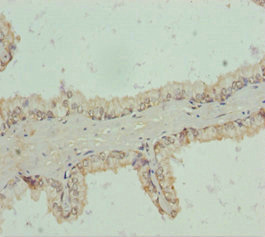
The antibody against RNF34 was raised in rabbit using the Recombinant Human E3 ubiquitin-protein ligase RNF34 protein (1-220AA) as the immunogen. This antibody exists as a non-conjugated isotype IgG, Antigen affinity purified. This antibody has been validated on ELISA, WB, IHC.
$299.00
| Cat.No | ADC-16914A | Clonality | Polyclonal |
|---|---|---|---|
| Host Species | Rabbit | Target Name | RNF34 |
| Form | Liquid | Species Reactivity | Human |
| Isotype | IgG | Storage Buffer | 50% Glycerol, PBS with 0.02% sodium azide, pH7.3. |
| Purification Method | Antigen affinity purified | Conjugate | Non-conjugated |
| Application | ELISA, IHC, WB | Storage | Upon receipt |
| Immunogen Description | Recombinant Human E3 ubiquitin-protein ligase RNF34 protein (1-220AA) | Target Species | Human |
|---|---|---|---|
| Immunogen Sequence | Complete sequences for the immunogen, target protein, and peptides are available upon request. | Uniprot ID | Q969K3 |
Uniprot Id
Q969K3
Target Species
Human
Target Name
RNF34
Target Full Name
E3 ubiquitin-protein ligase RNF34
Target Function
E3 ubiquitin-protein ligase that regulates several biological processes through the ubiquitin-mediated proteasomal degradation of various target proteins. Ubiquitinates the caspases CASP8 and CASP10, promoting their proteasomal degradation, to negatively regulate cell death downstream of death domain receptors in the extrinsic pathway of apoptosis. May mediate 'Lys-48'-linked polyubiquitination of RIPK1 and its subsequent proteasomal degradation thereby indirectly regulating the tumor necrosis factor-mediated signaling pathway (Ref.13). Negatively regulates p53/TP53 through its direct ubiquitination and targeting to proteasomal degradation. Indirectly, may also negatively regulate p53/TP53 through ubiquitination and degradation of SFN. Mediates PPARGC1A proteasomal degradation probably through ubiquitination thereby indirectly regulating the metabolism of brown fat cells. Possibly involved in innate immunity, through 'Lys-48'-linked polyubiquitination of NOD1 and its subsequent proteasomal degradation.
Target Subcellular Location
Cell membrane; Peripheral membrane protein. Endomembrane system; Peripheral membrane protein. Nucleus. Nucleus speckle. Cytoplasm, cytosol.
Target Tissue Specificity
Ubiquitous. Detected in heart, brain, liver, skeletal muscle, kidney, pancreas, spleen, thymus, prostate, testis, ovary, colon and leukocytes.
Target Synonyms
CARP 1; CARP-1; CARP1; Caspase regulator CARP1; Caspases-8 and -10-associated RING finger protein 1; E3 ubiquitin-protein ligase RNF34; FYVE-RING finger protein Momo; hRFI; Human RING finger homologous to inhibitor of apoptosis protein; RFI; RIF; RIFF; RING finger protein 34; RING finger protein RIFF; RNF34; RNF34_HUMAN
Target Background
The protein encoded by this gene contains a RINF finger, a motif known to be involved in protein-protein and protein-DNA interactions. This protein interacts with DNAJA3/hTid-1, which is a DnaJ protein reported to function as a modulator of apoptosis. Overexpression of this gene in Hela cells was shown to confer the resistance to TNF-alpha induced apoptosis, suggesting an anti-apoptotic function of this protein. This protein can be cleaved by caspase-3 during the induction of apoptosis. This protein also targets p53 and phospho-p53 for degradation. Alternatively splicing results in multiple transcript variants encoding distinct isoforms.
Notification