-
Chinese (Simplified)
-
English
-
German
-
Korean
-
Spanish
Chinese (Simplified)
English
German
Korean
Spanish
Sign up for an account to enjoy easy online shopping and instant order tracking.
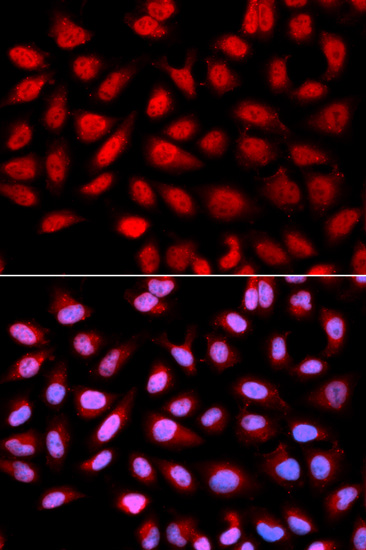
The antibody against Ser/thr-PP2A activator (PTPA) was raised in Rabbit using the recombinant fusion protein containing a sequence corresponding to amino acids 1-323 of human Ser/thr-PP2A activator (PTPA) (NP_821067.1) as the immunogen. The polyclonal antibody exists as a isotype IgG, by affinity purification. This antibody has been validated on IF/ICC, ELISA.
| Cat.No | ADA-11675A | Clonality | Polyclonal |
|---|---|---|---|
| Host Species | Rabbit | Target Name | Ser/thr-PP2A activator (PTPA) |
| Target Synonyms | PP2A; PR53; PPP2R4; Ser/thr-PP2A activator (PTPA) | Form | Liquid |
| Species Reactivity | Human, Mouse | Isotype | IgG |
| Storage Buffer | 50% Glycerol, PBS with 0.02% sodium azide, pH7.3. | Purification Method | Affinity purification |
| Application | ELISA, IF/ICC |
| Immunogen Description | Recombinant fusion protein containing a sequence corresponding to amino acids 1-323 of human Ser/thr-PP2A activator (PTPA) (NP_821067.1). | Target Species | Human |
|---|---|---|---|
| Uniprot ID | Q15257 | Immunogen Sequence |
Uniprot Id
Q15257
Target Species
Human
Target Name
PTPA
Target Full Name
Serine/threonine-protein phosphatase 2A activator
Target Function
PPIases accelerate the folding of proteins. It catalyzes the cis-trans isomerization of proline imidic peptide bonds in oligopeptides. Acts as a regulatory subunit for serine/threonine-protein phosphatase 2A (PP2A) modulating its activity or substrate specificity, probably by inducing a conformational change in the catalytic subunit, a proposed direct target of the PPIase. Can reactivate inactive phosphatase PP2A-phosphatase methylesterase complexes (PP2A(i)) in presence of ATP and Mg(2+). Reversibly stimulates the variable phosphotyrosyl phosphatase activity of PP2A core heterodimer PP2A(D) in presence of ATP and Mg(2+) (in vitro). The phosphotyrosyl phosphatase activity is dependent of an ATPase activity of the PP2A(D):PPP2R4 complex. Is involved in apoptosis; the function appears to be independent from PP2A.
Target Subcellular Location
Cytoplasm. Nucleus.
Target Protein Families
PTPA-type PPIase family
Target Tissue Specificity
Widely expressed.
Target Research Area
others
Target Synonyms
subunit B''; KIAA0044; MGC2184; Phosphotyrosyl phosphatase activator; PP2A; PP2A phosphatase activator; PP2A subunit B'; PP2A subunit B' isoform PR53; PP2A subunit B' PR53 isoform; PPP2R4; PR53; PR53 isoform; Protein phosphatase 2, regulatory subunit B-prime; Protein phosphatase 2A activator regulatory subunit 4; Protein phosphatase 2A regulatory subunit B' (PR 53); PTPA; PTPA_HUMAN; Serine/threonine protein phosphatase 2A regulatory subunit B'; Serine/threonine-protein phosphatase 2A activator; Serine/threonine-protein phosphatase 2A regulatory subunit 4; Serine/threonine-protein phosphatase 2A regulatory subunit B''
Target Background
Protein phosphatase 2A is one of the four major Ser/Thr phosphatases and is implicated in the negative control of cell growth and division. Protein phosphatase 2A holoenzymes are heterotrimeric proteins composed of a structural subunit A, a catalytic subunit C, and a regulatory subunit B. The regulatory subunit is encoded by a diverse set of genes that have been grouped into the B/PR55, B'/PR61, and B''/PR72 families. These different regulatory subunits confer distinct enzymatic specificities and intracellular localizations to the holozenzyme. The product of this gene belongs to the B' family. This gene encodes a specific phosphotyrosyl phosphatase activator of the dimeric form of protein phosphatase 2A. Alternative splicing results in multiple transcript variants encoding different isoforms.
Notification