-
Chinese (Simplified)
-
English
-
German
-
Korean
-
Spanish
Chinese (Simplified)
English
German
Korean
Spanish
Sign up for an account to enjoy easy online shopping and instant order tracking.
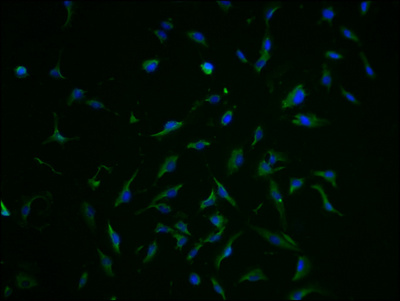
The antibody against SLC1A3 was raised in rabbit using the Recombinant Human Excitatory amino acid transporter 1 protein (146-236AA) as the immunogen. This antibody exists as a non-conjugated isotype IgG, purified by protein G with a purity greater than 95%. This antibody has been validated on ELISA, IHC, IF.
$299.00
| Cat.No | ADC-00148A | Clonality | Polyclonal |
|---|---|---|---|
| Host Species | Rabbit | Target Name | SLC1A3 |
| Form | Liquid | Species Reactivity | Human |
| Isotype | IgG | Storage Buffer | 0.01M PBS, 0.03% Proclin 300; Constituents: 50% Glycerol, PH 7.4 |
| Purification Method | >95%, Protein G purified | Conjugate | Non-conjugated |
| Application | ELISA, IF, IHC | Storage | Upon receipt |
| Immunogen Description | Recombinant Human Excitatory amino acid transporter 1 protein (146-236AA) | Target Species | Human |
|---|---|---|---|
| Immunogen Sequence | Complete sequences for the immunogen, target protein, and peptides are available upon request. | Uniprot ID | P43003 |
Uniprot Id
P43003
Target Species
Human
Target Name
SLC1A3
Target Full Name
Excitatory amino acid transporter 1
Target Function
Sodium-dependent, high-affinity amino acid transporter that mediates the uptake of L-glutamate and also L-aspartate and D-aspartate. Functions as a symporter that transports one amino acid molecule together with two or three Na(+) ions and one proton, in parallel with the counter-transport of one K(+) ion. Mediates Cl(-) flux that is not coupled to amino acid transport; this avoids the accumulation of negative charges due to aspartate and Na(+) symport. Plays a redundant role in the rapid removal of released glutamate from the synaptic cleft, which is essential for terminating the postsynaptic action of glutamate.
Target Involvement
Episodic ataxia 6 (EA6)
Target Subcellular Location
Cell membrane; Multi-pass membrane protein.
Target Protein Families
Dicarboxylate/amino acid:cation symporter (DAACS) (TC 2.A.23) family, SLC1A3 subfamily
Target Tissue Specificity
Detected in brain. Detected at very much lower levels in heart, lung, placenta and skeletal muscle. Highly expressed in cerebellum, but also found in frontal cortex, hippocampus and basal ganglia.
Target Research Area
Neuroscience
Target Synonyms
EA6; EAA1_HUMAN; EAAT1; Excitatory amino acid transporter 1; FLJ25094 ; GLAST; GLAST-1; GLAST1; Glial high affinity glutamate transporter; glutamate/aspartate transporter; high affinity; sodium-dependent; High affinity neuronal glutamate transporter; Slc1a3; Sodium dependent glutamate/aspartate transporter; Sodium-dependent glutamate/aspartate transporter 1; Solute carrier family 1 (glial high affinity glutamate transporter) member 3; Solute carrier family 1 member 3
Target Background
This gene encodes a member of a member of a high affinity glutamate transporter family. This gene functions in the termination of excitatory neurotransmission in central nervous system. Mutations are associated with episodic ataxia, Type 6. Alternative splicing results in multiple transcript variants.
Notification