-
Chinese (Simplified)
-
English
-
German
-
Korean
-
Spanish

Chinese (Simplified)
English
German
Korean
Spanish
Sign up for an account to enjoy easy online shopping and instant order tracking.
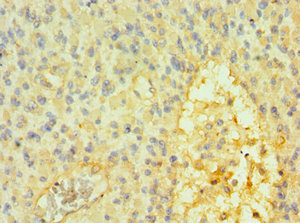
The antibody against SOX14 was raised in rabbit using the Recombinant Human Transcription factor SOX-14 protein (91-240AA) as the immunogen. This antibody exists as a non-conjugated isotype IgG, Antigen affinity purified. This antibody has been validated on ELISA, IHC.
$299.00
| Cat.No | ADC-44560A | Clonality | Polyclonal |
|---|---|---|---|
| Host Species | Rabbit | Target Name | SOX14 |
| Target Synonyms | SOX14 antibody; SOX28 antibody; Transcription factor SOX-14 antibody; Protein SOX-28 antibody | Form | Liquid |
| Species Reactivity | Human | Isotype | IgG |
| Storage Buffer | 50% Glycerol, PBS with 0.02% sodium azide, pH7.3. | Purification Method | Antigen affinity purified |
| Conjugate | Non-conjugated | Application | ELISA, IHC |
| Storage | Upon receipt |
| Immunogen Description | Recombinant Human Transcription factor SOX-14 protein (91-240AA) | Target Species | Human |
|---|---|---|---|
| Immunogen Sequence | Complete sequences for the immunogen, target protein, and peptides are available upon request. | Uniprot ID | O95416 |
Uniprot Id
O95416
Target Species
Human
Target Name
SOX14
Target Full Name
Transcription factor SOX-14
Target Function
Acts as a negative regulator of transcription.
Target Subcellular Location
Nucleus.
Target Synonyms
SOX14; SOX28; Transcription factor SOX-14; Protein SOX-28
Target Background
This intronless gene encodes a member of the SOX (SRY-related HMG-box) family of transcription factors involved in the regulation of embryonic development and in the determination of the cell fate. The encoded protein may act as a transcriptional regulator after forming a protein complex with other proteins. Mutations in this gene are suggested to be responsible for the limb defects associated with blepharophimosis, ptosis, epicanthus inversus syndrome (BPES) and Mobius syndrome.
Notification