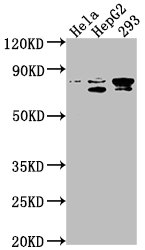
-
Chinese (Simplified)
-
English
-
German
-
Korean
-
Spanish

Chinese (Simplified)
English
German
Korean
Spanish
Sign up for an account to enjoy easy online shopping and instant order tracking.
The antibody against SRPK2 was raised in rabbit using the Recombinant Human SRSF protein kinase 2 protein (471-688AA) as the immunogen. This antibody exists as a non-conjugated isotype IgG, Antigen affinity purified. This antibody has been validated on ELISA, WB, IHC.
$299.00
| Cat.No | ADC-01604A | Clonality | Polyclonal |
|---|---|---|---|
| Host Species | Rabbit | Target Name | SRPK2 |
| Target Synonyms | Human serine kinase SRPK2 mRNA | Form | Liquid |
| Species Reactivity | Human | Isotype | IgG |
| Storage Buffer | 0.01M PBS, 0.03% Proclin 300; Constituents: 50% Glycerol, PH 7.4 | Purification Method | Antigen affinity purified |
| Conjugate | Non-conjugated | Application | ELISA, IHC, WB |
| Storage | Upon receipt |
| Immunogen Description | Recombinant Human SRSF protein kinase 2 protein (471-688AA) | Target Species | Human |
|---|---|---|---|
| Immunogen Sequence | Complete sequences for the immunogen, target protein, and peptides are available upon request. | Uniprot ID | P78362 |
Uniprot Id
P78362
Target Species
Human
Target Name
SRPK2
Target Full Name
SRSF protein kinase 2
Target Function
Serine/arginine-rich protein-specific kinase which specifically phosphorylates its substrates at serine residues located in regions rich in arginine/serine dipeptides, known as RS domains and is involved in the phosphorylation of SR splicing factors and the regulation of splicing. Promotes neuronal apoptosis by up-regulating cyclin-D1 (CCND1) expression. This is done by the phosphorylation of SRSF2, leading to the suppression of p53/TP53 phosphorylation thereby relieving the repressive effect of p53/TP53 on cyclin-D1 (CCND1) expression. Phosphorylates ACIN1, and redistributes it from the nuclear speckles to the nucleoplasm, resulting in cyclin A1 but not cyclin A2 up-regulation. Plays an essential role in spliceosomal B complex formation via the phosphorylation of DDX23/PRP28. Probably by phosphorylating DDX23, leads to the suppression of incorrect R-loops formed during transcription; R-loops are composed of a DNA:RNA hybrid and the associated non-template single-stranded DNA. Can mediate hepatitis B virus (HBV) core protein phosphorylation. Plays a negative role in the regulation of HBV replication through a mechanism not involving the phosphorylation of the core protein but by reducing the packaging efficiency of the pregenomic RNA (pgRNA) without affecting the formation of the viral core particles.
Target Subcellular Location
Cytoplasm. Nucleus, nucleoplasm. Nucleus speckle. Chromosome.
Target Protein Families
Protein kinase superfamily, CMGC Ser/Thr protein kinase family
Target Tissue Specificity
Highly expressed in brain, moderately expressed in heart and skeletal muscle and at low levels in lung, liver, and kidney.
Target Synonyms
Human serine kinase SRPK2 mRNA, complete cds; Serine kinase SRPK2; Serine/arginine rich protein specific kinase 2; Serine/arginine-rich protein-specific kinase 2; Serine/threonine protein kinase SRPK2; SFRS protein kinase 2; SFRSK2; SR protein specific kinase 2; SR-protein-specific kinase 2; SRPK2; SRPK2_HUMAN; SRSF protein kinase 2 C-terminal
Target Background
Enables ATP binding activity; magnesium ion binding activity; and protein serine/threonine kinase activity. Involved in several processes, including nucleic acid metabolic process; peptidyl-serine phosphorylation; and regulation of viral genome replication. Located in chromatin; cytosol; and nuclear lumen.
Notification