-
Chinese (Simplified)
-
English
-
German
-
Korean
-
Spanish
Chinese (Simplified)
English
German
Korean
Spanish
Sign up for an account to enjoy easy online shopping and instant order tracking.
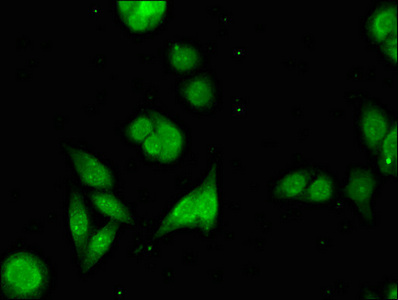
The antibody against PARG was raised in rabbit using the Recombinant Human Poly(ADP-ribose) glycohydrolase protein (1-348AA) as the immunogen. This antibody exists as a non-conjugated isotype IgG, purified by protein G with a purity greater than 95%. This antibody has been validated on ELISA, IF.
$299.00
| Cat.No | ADC-11815A | Clonality | Polyclonal |
|---|---|---|---|
| Host Species | Rabbit | Target Name | PARG |
| Form | Liquid | Species Reactivity | Human |
| Isotype | IgG | Storage Buffer | 0.01M PBS, 0.03% Proclin 300; Constituents: 50% Glycerol, PH 7.4 |
| Purification Method | >95%, Protein G purified | Conjugate | Non-conjugated |
| Application | ELISA, IF | Storage | Upon receipt |
| Immunogen Description | Recombinant Human Poly(ADP-ribose) glycohydrolase protein (1-348AA) | Target Species | Human |
|---|---|---|---|
| Immunogen Sequence | Complete sequences for the immunogen, target protein, and peptides are available upon request. | Uniprot ID | Q86W56 |
Uniprot Id
Q86W56
Target Species
Human
Target Name
PARG
Target Full Name
Poly(ADP-ribose) glycohydrolase
Target Function
Poly(ADP-ribose) glycohydrolase that degrades poly(ADP-ribose) by hydrolyzing the ribose-ribose bonds present in poly(ADP-ribose). PARG acts both as an endo- and exoglycosidase, releasing poly(ADP-ribose) of different length as well as ADP-ribose monomers. It is however unable to cleave the ester bond between the terminal ADP-ribose and ADP-ribosylated residues, leaving proteins that are mono-ADP-ribosylated. Poly(ADP-ribose) is synthesized after DNA damage is only present transiently and is rapidly degraded by PARG. Required to prevent detrimental accumulation of poly(ADP-ribose) upon prolonged replicative stress, while it is not required for recovery from transient replicative stress. Responsible for the prevalence of mono-ADP-ribosylated proteins in cells, thanks to its ability to degrade poly(ADP-ribose) without cleaving the terminal protein-ribose bond. Required for retinoid acid-dependent gene transactivation, probably by removing poly(ADP-ribose) from histone demethylase KDM4D, allowing chromatin derepression at RAR-dependent gene promoters. Involved in the synthesis of ATP in the nucleus, together with PARP1, NMNAT1 and NUDT5. Nuclear ATP generation is required for extensive chromatin remodeling events that are energy-consuming.
Target Subcellular Location
[Isoform 1]: Nucleus.; [Isoform 2]: Cytoplasm.; [Isoform 3]: Cytoplasm.; [Isoform 4]: Cytoplasm. Mitochondrion.; [Isoform 5]: Mitochondrion matrix.
Target Protein Families
Poly(ADP-ribose) glycohydrolase family
Target Tissue Specificity
Ubiquitously expressed.
Target Synonyms
ADP riboseglycohydrolase; Mitochondrial poly(ADP ribose) glycohydrolase; Parg; PARG_HUMAN; PARG99 ; Poly ; poly (ADP ribose) glycohydrolase; poly(ADP-ribose) glycohydrolase 60 kDa isoform; Poly(ADP-ribose) glycohydrolase
Target Background
Poly(ADP-ribose) glycohydrolase (PARG) is the major enzyme responsible for the catabolism of poly(ADP-ribose), a reversible covalent-modifier of chromosomal proteins. The protein is found in many tissues and may be subject to proteolysis generating smaller, active products. Several transcript variants encoding different isoforms have been found for this gene.
Notification