-
Chinese (Simplified)
-
English
-
German
-
Korean
-
Spanish
Chinese (Simplified)
English
German
Korean
Spanish
Sign up for an account to enjoy easy online shopping and instant order tracking.
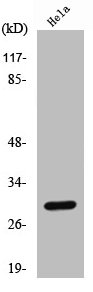
The antibody against CTSL was raised in rabbit using the Synthesized peptide derived from the C-terminal region of Human Cathepsin L1 HC. as the immunogen. This antibody exists as a non-conjugated isotype IgG. The antibody was affinity-purified from rabbit antiserum by affinity-chromatography using epitope-specific immunogen. This antibody has been validated on WB, ELISA.
$167.00
| Cat.No | ADC-39944A | Clonality | Polyclonal |
|---|---|---|---|
| Host Species | Rabbit | Target Name | CTSL |
| Form | Liquid | Species Reactivity | Human |
| Isotype | IgG | Storage Buffer | 0.5% BSA and 0.02% sodium azide., Liquid in PBS containing 50% glycerol |
| Purification Method | The antibody was affinity-purified from rabbit antiserum by affinity-chromatography using epitope-specific immunogen. | Conjugate | Non-conjugated |
| Application | ELISA, WB | Storage | Upon receipt |
| Immunogen Description | Synthesized peptide derived from the C-terminal region of Human Cathepsin L1 HC. | Target Species | Human |
|---|---|---|---|
| Immunogen Sequence | Complete sequences for the immunogen, target protein, and peptides are available upon request. | Uniprot ID | P07711 |
Uniprot Id
P07711
Target Species
Human
Target Name
CTSL
Target Full Name
Procathepsin L
Target Function
Thiol protease important for the overall degradation of proteins in lysosomes (Probable). Plays a critical for normal cellular functions such as general protein turnover, antigen processing and bone remodeling. Involved in the solubilization of cross-linked TG/thyroglobulin and in the subsequent release of thyroid hormone thyroxine (T4) by limited proteolysis of TG/thyroglobulin in the thyroid follicle lumen. In neuroendocrine chromaffin cells secretory vesicles, catalyzes the prohormone proenkephalin processing to the active enkephalin peptide neurotransmitter. In thymus, regulates CD4(+) T cell positive selection by generating the major histocompatibility complex class II (MHCII) bound peptide ligands presented by cortical thymic epithelial cells. Also mediates invariant chain processing in cortical thymic epithelial cells. Major elastin-degrading enzyme at neutral pH. Accumulates as a mature and active enzyme in the extracellular space of antigen presenting cells (APCs) to regulate degradation of the extracellular matrix in the course of inflammation. Secreted form generates endostatin from COL18A1. Critical for cardiac morphology and function. Plays an important role in hair follicle morphogenesis and cycling, as well as epidermal differentiation. Required for maximal stimulation of steroidogenesis by TIMP1.; Functions in the regulation of cell cycle progression through proteolytic processing of the CUX1 transcription factor. Translation initiation at downstream start sites allows the synthesis of isoforms that are devoid of a signal peptide and localize to the nucleus where they cleave the CUX1 transcription factor and modify its DNA binding properties.; (Microbial infection) In cells lacking TMPRSS2 expression, facilitates human coronaviruses SARS-CoV and SARS-CoV-2 infections via a slow acid-activated route with the proteolysis of coronavirus spike (S) glycoproteins in lysosome for entry into host cell. Proteolysis within lysosomes is sufficient to activate membrane fusion by coronaviruses SARS-CoV and EMC (HCoV-EMC) S as well as Zaire ebolavirus glycoproteins.
Target Subcellular Location
Lysosome. Apical cell membrane; Peripheral membrane protein; Extracellular side. Cytoplasmic vesicle, secretory vesicle, chromaffin granule. Secreted, extracellular space. Secreted.; [Isoform 2]: Nucleus.
Target Protein Families
Peptidase C1 family
Target Synonyms
Cathepsin L; cathepsin L; 1 b; Cathepsin L1; Cathepsin L1 light chain; CathepsinL; CATL; CATL1_HUMAN; cb15; CTSL; CTSL1; ctsl1b; FLJ31037; hgg1; Major excreted protein; MEP; MGC123162; wu:fb30g09
Target Background
The protein encoded by this gene is a lysosomal cysteine proteinase that plays a major role in intracellular protein catabolism. Its substrates include collagen and elastin, as well as alpha-1 protease inhibitor, a major controlling element of neutrophil elastase activity. The encoded protein has been implicated in several pathologic processes, including myofibril necrosis in myopathies and in myocardial ischemia, and in the renal tubular response to proteinuria. This protein, which is a member of the peptidase C1 family, is a dimer composed of disulfide-linked heavy and light chains, both produced from a single protein precursor. Additionally, this protein cleaves the S1 subunit of the SARS-CoV-2 spike protein, which is necessary for entry of the virus into the cell.
Notification