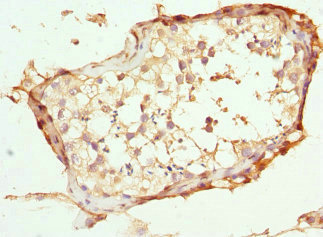
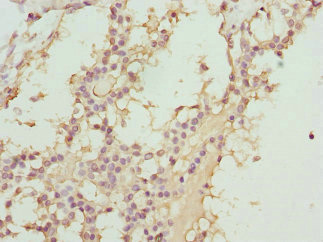
-
Chinese (Simplified)
-
English
-
German
-
Korean
-
Spanish
Chinese (Simplified)
English
German
Korean
Spanish
Sign up for an account to enjoy easy online shopping and instant order tracking.
The antibody against ABCC11 was raised in rabbit using the Recombinant Human ATP-binding cassette sub-family C member 11 protein (1-170AA) as the immunogen. This antibody exists as a non-conjugated isotype IgG, Antigen affinity purified. This antibody has been validated on ELISA, IHC.
$299.00
| Cat.No | ADC-17332A | Clonality | Polyclonal |
|---|---|---|---|
| Host Species | Rabbit | Target Name | ABCC11 |
| Form | Liquid | Species Reactivity | Human |
| Isotype | IgG | Storage Buffer | 50% Glycerol, PBS with 0.02% sodium azide, pH7.3. |
| Purification Method | Antigen affinity purified | Conjugate | Non-conjugated |
| Application | ELISA, IHC | Storage | Upon receipt |
| Immunogen Description | Recombinant Human ATP-binding cassette sub-family C member 11 protein (1-170AA) | Target Species | Human |
|---|---|---|---|
| Immunogen Sequence | Complete sequences for the immunogen, target protein, and peptides are available upon request. | Uniprot ID | Q96J66 |
Uniprot Id
Q96J66
Target Species
Human
Target Name
ABCC11
Target Full Name
ATP-binding cassette sub-family C member 11
Target Function
ATP-dependent transporter of the ATP-binding cassette (ABC) family that actively extrudes physiological compounds, and xenobiotics from cells. Participates in physiological processes involving bile acids, conjugated steroids and cyclic nucleotides. Stimulates the ATP-dependent uptake of a range of physiological lipophilic anions, including the glutathione S-conjugates leukotriene C4 and dinitrophenyl S-glutathione, steroid sulfates such as dehydroepiandrosterone 3-sulfate (DHEAS) and estrone 3-sulfate, glucuronides such as estradiol 17-beta-D-glucuronide (E(2)17betaG), the monoanionic bile acids glycocholate and taurocholate, and methotrexate. Enhances also the cellular extrusion of cAMP and cGMP. Confers resistance to anticancer drugs, such as 5-fluorouracil (5-FU) and methotrexate. Probably functions to secrete earwax. Required for the secretion of components contributing to axillary odor formation.
Target Subcellular Location
Cell membrane; Multi-pass membrane protein. Vacuole membrane. Cytoplasmic vesicle membrane. Apical cell membrane; Multi-pass membrane protein.
Target Protein Families
ABC transporter superfamily, ABCC family, Conjugate transporter (TC 3.A.1.208) subfamily
Target Tissue Specificity
Expressed in ceruminous apocrine gland (at protein level). Expressed in many tissues. Not expressed in kidney, spleen and colon. Highly expressed in breast cancer. Expressed at moderate levels in normal breast and testis and at very low levels in liver, b
Target Synonyms
ABCC 11; ABCC11; ABCCB_HUMAN; ATP binding cassette protein C11; ATP binding cassette sub family C (CFTR/MRP) member 11; ATP binding cassette sub family C member 11; ATP binding cassette transporter MRP8; ATP binding cassette transporter sub family C member 11; ATP-binding cassette sub-family C member 11; EWWD; MRP8; Multi resistance protein 8; Multidrug resistance associated protein 8; Multidrug resistance-associated protein 8; OTTHUMP00000164191; WW
Target Background
The protein encoded by this gene is a member of the superfamily of ATP-binding cassette (ABC) transporters. ABC proteins transport various molecules across extra- and intra-cellular membranes. ABC genes are divided into seven distinct subfamilies (ABC1, MDR/TAP, MRP, ALD, OABP, GCN20, White). This ABC full transporter is a member of the MRP subfamily which is involved in multi-drug resistance. The product of this gene participates in physiological processes involving bile acids, conjugated steroids, and cyclic nucleotides. In addition, a SNP in this gene is responsible for determination of human earwax type. This gene and family member ABCC12 are determined to be derived by duplication and are both localized to chromosome 16q12.1. Multiple alternatively spliced transcript variants have been described for this gene.
Notification