-
Chinese (Simplified)
-
English
-
German
-
Korean
-
Spanish
Chinese (Simplified)
English
German
Korean
Spanish
Sign up for an account to enjoy easy online shopping and instant order tracking.
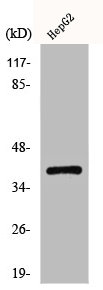
The antibody against ACKR4 was raised in rabbit using the Synthesized peptide derived from the C-terminal region of Human CCRL1. as the immunogen. This antibody exists as a non-conjugated isotype IgG. The antibody was affinity-purified from rabbit antiserum by affinity-chromatography using epitope-specific immunogen. This antibody has been validated on WB, IF, ELISA.
$167.00
| Cat.No | ADC-39104A | Clonality | Polyclonal |
|---|---|---|---|
| Host Species | Rabbit | Target Name | ACKR4 |
| Target Synonyms | ACKR4; CCBP2; CCR11; CCRL1; VSHK1; Atypical chemokine receptor 4; C-C chemokine receptor type 11; C-C CKR-11; CC-CKR-11; CCR-11; CC chemokine receptor-like 1; CCX CKR | Form | Liquid |
| Species Reactivity | Human, Mouse | Isotype | IgG |
| Storage Buffer | 0.5% BSA and 0.02% sodium azide., Liquid in PBS containing 50% glycerol | Purification Method | The antibody was affinity-purified from rabbit antiserum by affinity-chromatography using epitope-specific immunogen. |
| Conjugate | Non-conjugated | Application | ELISA, IF, WB |
| Storage | Upon receipt |
| Immunogen Description | Synthesized peptide derived from the C-terminal region of Human CCRL1. | Target Species | Human |
|---|---|---|---|
| Immunogen Sequence | Complete sequences for the immunogen, target protein, and peptides are available upon request. | Uniprot ID | Q9NPB9 |
Uniprot Id
Q9NPB9
Target Species
Human
Target Name
ACKR4
Target Full Name
Atypical chemokine receptor 4
Target Function
Atypical chemokine receptor that controls chemokine levels and localization via high-affinity chemokine binding that is uncoupled from classic ligand-driven signal transduction cascades, resulting instead in chemokine sequestration, degradation, or transcytosis. Also known as interceptor (internalizing receptor) or chemokine-scavenging receptor or chemokine decoy receptor. Acts as a receptor for chemokines CCL2, CCL8, CCL13, CCL19, CCL21 and CCL25. Chemokine-binding does not activate G-protein-mediated signal transduction but instead induces beta-arrestin recruitment, leading to ligand internalization. Plays an important role in controlling the migration of immune and cancer cells that express chemokine receptors CCR7 and CCR9, by reducing the availability of CCL19, CCL21, and CCL25 through internalization. Negatively regulates CXCR3-induced chemotaxis. Regulates T-cell development in the thymus.
Target Subcellular Location
Early endosome. Recycling endosome. Cell membrane; Multi-pass membrane protein. Note=Predominantly localizes to endocytic vesicles, and upon stimulation by the ligand is internalized via caveolae. Once internalized, the ligand dissociates from the receptor, and is targeted to degradation while the receptor is recycled back to the cell membrane.
Target Protein Families
G-protein coupled receptor 1 family, Atypical chemokine receptor subfamily
Target Tissue Specificity
Predominantly expressed in heart. Lower expression in lung, pancreas, spleen, colon, skeletal muscle and small intestine.
Target Synonyms
ACKR4; CCBP2; CCR11; CCRL1; VSHK1; Atypical chemokine receptor 4; C-C chemokine receptor type 11; C-C CKR-11; CC-CKR-11; CCR-11; CC chemokine receptor-like 1; CCX CKR
Notification