-
Chinese (Simplified)
-
English
-
German
-
Korean
-
Spanish
Chinese (Simplified)
English
German
Korean
Spanish
Sign up for an account to enjoy easy online shopping and instant order tracking.
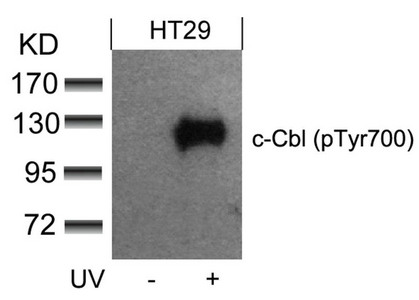
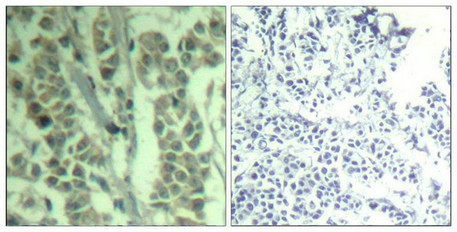
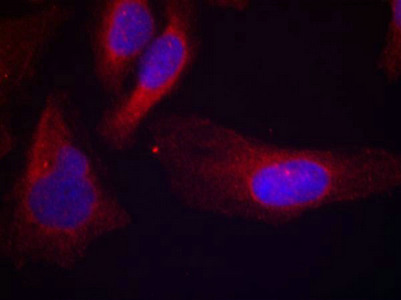
The antibody against CBL was raised in rabbit using the Peptide sequence around phosphorylation site of tyrosine 770 (T-E-Y(p)-M-T) derived from Human c-Cbl. as the immunogen. Antibodies were produced by immunizing rabbits with synthetic phosphopeptide and KLH conjugates. Antibodies were purified by affinity-chromatography using epitope-specific phosphopeptide. Non-phospho specific antibodies were removed by chromatogramphy usi This antibody has been validated on ELISA, WB, IHC, IF.
$360.00
| Cat.No | ADC-43564A | Clonality | Polyclonal |
|---|---|---|---|
| Host Species | Rabbit | Target Name | CBL |
| Form | Liquid | Species Reactivity | Human |
| Storage Buffer | PH 7.4, 0.02% sodium azide and 50% glycerol., 150mM NaCl, Supplied at 1.0mg/mL in phosphate buffered saline (without Mg2+ and Ca2+) | Application | ELISA, IF, IHC, WB |
| Storage | Upon receipt |
| Immunogen Description | Peptide sequence around phosphorylation site of tyrosine 770 (T-E-Y(p)-M-T) derived from Human c-Cbl. | Target Species | Human |
|---|---|---|---|
| Immunogen Sequence | Complete sequences for the immunogen, target protein, and peptides are available upon request. | Uniprot ID | P22681 |
Uniprot Id
P22681
Target Species
Human
Target Name
CBL
Target Full Name
E3 ubiquitin-protein ligase CBL
Target Function
Adapter protein that functions as a negative regulator of many signaling pathways that are triggered by activation of cell surface receptors. Acts as an E3 ubiquitin-protein ligase, which accepts ubiquitin from specific E2 ubiquitin-conjugating enzymes, and then transfers it to substrates promoting their degradation by the proteasome. Ubiquitinates SPRY2. Ubiquitinates EGFR. Recognizes activated receptor tyrosine kinases, including KIT, FLT1, FGFR1, FGFR2, PDGFRA, PDGFRB, CSF1R, EPHA8 and KDR and terminates signaling. Recognizes membrane-bound HCK, SRC and other kinases of the SRC family and mediates their ubiquitination and degradation. Participates in signal transduction in hematopoietic cells. Plays an important role in the regulation of osteoblast differentiation and apoptosis. Essential for osteoclastic bone resorption. The 'Tyr-731' phosphorylated form induces the activation and recruitment of phosphatidylinositol 3-kinase to the cell membrane in a signaling pathway that is critical for osteoclast function. May be functionally coupled with the E2 ubiquitin-protein ligase UB2D3. In association with CBLB, required for proper feedback inhibition of ciliary platelet-derived growth factor receptor-alpha (PDGFRA) signaling pathway via ubiquitination and internalization of PDGFRA.
Target Involvement
Noonan syndrome-like disorder with or without juvenile myelomonocytic leukemia (NSLL)
Target Subcellular Location
Cytoplasm. Cell membrane. Cell projection, cilium. Golgi apparatus. Note=Colocalizes with FGFR2 in lipid rafts at the cell membrane.
Target Synonyms
4732447J05Rik; C CBL; Cas Br M (murine) ecotropic retroviral transforming sequence; Casitas B lineage lymphoma proto oncogene; Casitas B-lineage lymphoma proto-oncogene; CBL 2; cbl; CBL_HUMAN; CBL2; E3 ubiquitin protein ligase CBL; E3 ubiquitin-protein ligase CBL; Oncogene CBL2; Proto oncogene c CBL; Proto-oncogene c-CBL; RGD1561386; RING finger protein 55; RNF55; Signal transduction protein CBL
Target Background
This gene is a proto-oncogene that encodes a RING finger E3 ubiquitin ligase. The encoded protein is one of the enzymes required for targeting substrates for degradation by the proteasome. This protein mediates the transfer of ubiquitin from ubiquitin conjugating enzymes (E2) to specific substrates. This protein also contains an N-terminal phosphotyrosine binding domain that allows it to interact with numerous tyrosine-phosphorylated substrates and target them for proteasome degradation. As such it functions as a negative regulator of many signal transduction pathways. This gene has been found to be mutated or translocated in many cancers including acute myeloid leukaemia, and expansion of CGG repeats in the 5' UTR has been associated with Jacobsen syndrome. Mutations in this gene are also the cause of Noonan syndrome-like disorder.
Notification