-
Chinese (Simplified)
-
English
-
German
-
Korean
-
Spanish
Chinese (Simplified)
English
German
Korean
Spanish
Sign up for an account to enjoy easy online shopping and instant order tracking.
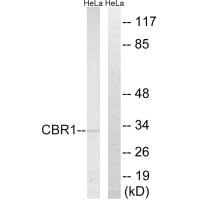
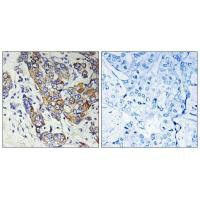
The antibody against CBR1 was raised in rabbit using the Synthesized peptide derived from internal of Human CBR1. as the immunogen. The antibody was affinity-purified from rabbit antiserum by affinity-chromatography using epitope-specific immunogen. This antibody has been validated on ELISA, WB, IHC.
$297.00
| Cat.No | ADC-41366A | Clonality | Polyclonal |
|---|---|---|---|
| Host Species | Rabbit | Target Name | CBR1 |
| Form | Liquid | Species Reactivity | Human |
| Storage Buffer | PH 7.4, 0.02% sodium azide and 50% glycerol., 150mM NaCl, Rabbit IgG in phosphate buffered saline (without Mg2+ and Ca2+) | Purification Method | The antibody was affinity-purified from rabbit antiserum by affinity-chromatography using epitope-specific immunogen. |
| Application | ELISA, IHC, WB | Storage | Upon receipt |
| Immunogen Description | Synthesized peptide derived from internal of Human CBR1. | Target Species | Human |
|---|---|---|---|
| Immunogen Sequence | Complete sequences for the immunogen, target protein, and peptides are available upon request. | Uniprot ID | P16152 |
Uniprot Id
P16152
Target Species
Human
Target Name
CBR1
Target Full Name
Carbonyl reductase [NADPH] 1
Target Function
NADPH-dependent reductase with broad substrate specificity. Catalyzes the reduction of a wide variety of carbonyl compounds including quinones, prostaglandins, menadione, plus various xenobiotics. Catalyzes the reduction of the antitumor anthracyclines doxorubicin and daunorubicin to the cardiotoxic compounds doxorubicinol and daunorubicinol. Can convert prostaglandin E to prostaglandin F2-alpha. Can bind glutathione, which explains its higher affinity for glutathione-conjugated substrates. Catalyzes the reduction of S-nitrosoglutathione.
Target Subcellular Location
Cytoplasm.
Target Protein Families
Short-chain dehydrogenases/reductases (SDR) family
Target Tissue Specificity
Expressed in kidney (at protein level).
Target Research Area
Metabolism
Target Synonyms
15 hydroxyprostaglandin dehydrogenase [NADP+]; 15-hydroxyprostaglandin dehydrogenase [NADP+]; Carbonyl reductase [NADPH] 1; Carbonyl Reductase 1; CBR 1; CBR1; CBR1_HUMAN; CRN; NADPH dependent carbonyl reductase 1; NADPH-dependent carbonyl reductase 1; Prostaglandin 9 ketoreductase; Prostaglandin 9-ketoreductase; Prostaglandin E(2) 9 reductase; Prostaglandin-E(2) 9-reductase; SDR21C1
Target Background
The protein encoded by this gene belongs to the short-chain dehydrogenases/reductases (SDR) family, which function as NADPH-dependent oxidoreductases having wide specificity for carbonyl compounds, such as quinones, prostaglandins, and various xenobiotics. Alternatively spliced transcript variants have been found for this gene.
Notification