-
Chinese (Simplified)
-
English
-
German
-
Korean
-
Spanish
Chinese (Simplified)
English
German
Korean
Spanish
Sign up for an account to enjoy easy online shopping and instant order tracking.
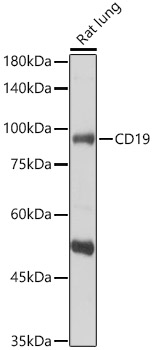
The antibody against CD19 was raised in Rabbit using a synthetic peptide corresponding to a sequence within amino acids 457-556 of human CD19 (NP_001761.3) as the immunogen. The polyclonal antibody exists as a isotype IgG, by affinity purification. This antibody has been validated on WB, IF/ICC, ELISA.
| Cat.No | ADA-11288A | Clonality | Polyclonal |
|---|---|---|---|
| Host Species | Rabbit | Target Name | CD19 |
| Target Synonyms | B4; CVID3; CD19 | Form | Liquid |
| Species Reactivity | Human, Mouse, Rat | Isotype | IgG |
| Storage Buffer | 50% Glycerol, PBS with 0.05% proclin300, pH7.3. | Purification Method | Affinity purification |
| Positive Samples | Rat lung | Application | ELISA, WB, IF/ICC |
| Immunogen Description | A synthetic peptide corresponding to a sequence within amino acids 457-556 of human CD19 (NP_001761.3). | Target Species | Human |
|---|---|---|---|
| Immunogen Sequence | NAESYENEDEELTQPVARTMDFLSPHGSAWDPSREATSLGSQSYEDMRGILYAAPQLRSIRGQPGPNHEEDADSYENMDNPDGPDPAWGGGGRMGTWSTR | Uniprot ID | P15391 |
Uniprot Id
P15391
Target Species
Human
Target Name
CD19
Target Full Name
B-lymphocyte antigen CD19
Target Function
Functions as coreceptor for the B-cell antigen receptor complex (BCR) on B-lymphocytes. Decreases the threshold for activation of downstream signaling pathways and for triggering B-cell responses to antigens. Activates signaling pathways that lead to the activation of phosphatidylinositol 3-kinase and the mobilization of intracellular Ca(2+) stores. Is not required for early steps during B cell differentiation in the blood marrow. Required for normal differentiation of B-1 cells. Required for normal B cell differentiation and proliferation in response to antigen challenges. Required for normal levels of serum immunoglobulins, and for production of high-affinity antibodies in response to antigen challenge.
Target Involvement
Immunodeficiency, common variable, 3 (CVID3)
Target Subcellular Location
Cell membrane; Single-pass type I membrane protein. Membrane raft; Single-pass type I membrane protein.
Target Tissue Specificity
Detected on marginal zone and germinal center B cells in lymph nodes. Detected on blood B cells (at protein level).
Target Research Area
Immunology
Target Synonyms
CD19; B-lymphocyte antigen CD19; B-lymphocyte surface antigen B4; Differentiation antigen CD19; T-cell surface antigen Leu-12; CD antigen CD19
Target Background
This gene encodes a member of the immunoglobulin gene superfamily. Expression of this cell surface protein is restricted to B cell lymphocytes. This protein is a reliable marker for pre-B cells but its expression diminishes during terminal B cell differentiation in antibody secreting plasma cells. The protein has two N-terminal extracellular Ig-like domains separated by a non-Ig-like domain, a hydrophobic transmembrane domain, and a large C-terminal cytoplasmic domain. This protein forms a complex with several membrane proteins including complement receptor type 2 (CD21) and tetraspanin (CD81) and this complex reduces the threshold for antigen-initiated B cell activation. Activation of this B-cell antigen receptor complex activates the phosphatidylinositol 3-kinase signalling pathway and the subsequent release of intracellular stores of calcium ions. This protein is a target of chimeric antigen receptor (CAR) T-cells used in the treatment of lymphoblastic leukemia. Mutations in this gene are associated with the disease common variable immunodeficiency 3 (CVID3) which results in a failure of B-cell differentiation and impaired secretion of immunoglobulins. CVID3 is characterized by hypogammaglobulinemia, an inability to mount an antibody response to antigen, and recurrent bacterial infections. Alternative splicing results in multiple transcript variants encoding distinct isoforms.
Notification