-
Chinese (Simplified)
-
English
-
German
-
Korean
-
Spanish
Chinese (Simplified)
English
German
Korean
Spanish
Sign up for an account to enjoy easy online shopping and instant order tracking.
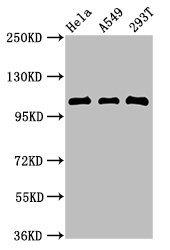
The antibody against ECT2 was raised in rabbit using the Recombinant Human Protein ECT2 protein (283-453AA) as the immunogen. This antibody exists as a non-conjugated isotype IgG, purified by protein G with a purity greater than 95%. This antibody has been validated on ELISA, WB, IHC, IP.
$299.00
| Cat.No | ADC-07407A | Clonality | Polyclonal |
|---|---|---|---|
| Host Species | Rabbit | Target Name | ECT2 |
| Target Synonyms | ECT2Protein ECT2 antibody; Epithelial cell-transforming sequence 2 oncogene antibody | Form | Liquid |
| Species Reactivity | Human | Isotype | IgG |
| Storage Buffer | 0.01M PBS, 0.03% Proclin 300; Constituents: 50% Glycerol, PH 7.4 | Purification Method | >95%, Protein G purified |
| Conjugate | Non-conjugated | Application | ELISA, IHC, WB, IP |
| Storage | Upon receipt |
| Immunogen Description | Recombinant Human Protein ECT2 protein (283-453AA) | Target Species | Human |
|---|---|---|---|
| Immunogen Sequence | Complete sequences for the immunogen, target protein, and peptides are available upon request. | Uniprot ID | Q9H8V3 |
Uniprot Id
Q9H8V3
Target Species
Human
Target Name
ECT2
Target Full Name
Protein ECT2
Target Function
Guanine nucleotide exchange factor (GEF) that catalyzes the exchange of GDP for GTP. Promotes guanine nucleotide exchange on the Rho family members of small GTPases, like RHOA, RHOC, RAC1 and CDC42. Required for signal transduction pathways involved in the regulation of cytokinesis. Component of the centralspindlin complex that serves as a microtubule-dependent and Rho-mediated signaling required for the myosin contractile ring formation during the cell cycle cytokinesis. Regulates the translocation of RHOA from the central spindle to the equatorial region. Plays a role in the control of mitotic spindle assembly; regulates the activation of CDC42 in metaphase for the process of spindle fibers attachment to kinetochores before chromosome congression. Involved in the regulation of epithelial cell polarity; participates in the formation of epithelial tight junctions in a polarity complex PARD3-PARD6-protein kinase PRKCQ-dependent manner. Plays a role in the regulation of neurite outgrowth. Inhibits phenobarbital (PB)-induced NR1I3 nuclear translocation. Stimulates the activity of RAC1 through its association with the oncogenic PARD6A-PRKCI complex in cancer cells, thereby acting to coordinately drive tumor cell proliferation and invasion. Also stimulates genotoxic stress-induced RHOB activity in breast cancer cells leading to their cell death.
Target Subcellular Location
Nucleus. Cytoplasm. Cytoplasm, cytoskeleton, spindle. Cleavage furrow. Midbody. Cell junction. Cell junction, tight junction. Note=Sequestered within the nucleus during interphase. Dispersed throughout the cytoplasm upon breakdown of the nuclear envelope during mitosis. Colocalizes with the centralspindlin complex to the mitotic spindles during anaphase/metaphase, the cleavage furrow during telophase and at the midbody at the end of cytokinesis. Colocalized with RhoA at the midbody. Its subcellular localization to tight junction is increased by calcium. Localized predominantly in the cytoplasm of numerous carcinoma cells.
Target Tissue Specificity
Expressed in lung epithelial cells (at protein level). Expressed in squamous cell carcinoma, primary non-small cell lung cancer tumors and lung adenocarcinoma.
Target Synonyms
ECT2Protein ECT2; Epithelial cell-transforming sequence 2 oncogene
Target Background
The protein encoded by this gene is a guanine nucleotide exchange factor and transforming protein that is related to Rho-specific exchange factors and yeast cell cycle regulators. The expression of this gene is elevated with the onset of DNA synthesis and remains elevated during G2 and M phases. In situ hybridization analysis showed that expression is at a high level in cells undergoing mitosis in regenerating liver. Thus, this protein is expressed in a cell cycle-dependent manner during liver regeneration, and is thought to have an important role in the regulation of cytokinesis. Several transcript variants encoding different isoforms have been found for this gene.
Notification