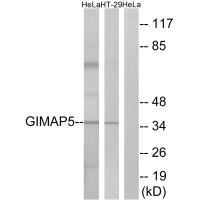
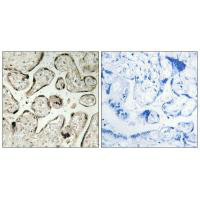
-
Chinese (Simplified)
-
English
-
German
-
Korean
-
Spanish
Chinese (Simplified)
English
German
Korean
Spanish
Sign up for an account to enjoy easy online shopping and instant order tracking.
The antibody against GIMAP5 was raised in rabbit using the Synthesized peptide derived from internal of Human GIMAP5. as the immunogen. The antibody was affinity-purified from rabbit antiserum by affinity-chromatography using epitope-specific immunogen. This antibody has been validated on ELISA, WB, IHC.
$297.00
| Cat.No | ADC-41206A | Clonality | Polyclonal |
|---|---|---|---|
| Host Species | Rabbit | Target Name | GIMAP5 |
| Form | Liquid | Species Reactivity | Human |
| Storage Buffer | PH 7.4, 0.02% sodium azide and 50% glycerol., 150mM NaCl, Rabbit IgG in phosphate buffered saline (without Mg2+ and Ca2+) | Purification Method | The antibody was affinity-purified from rabbit antiserum by affinity-chromatography using epitope-specific immunogen. |
| Application | ELISA, IHC, WB | Storage | Upon receipt |
| Immunogen Description | Synthesized peptide derived from internal of Human GIMAP5. | Target Species | Human |
|---|---|---|---|
| Immunogen Sequence | Complete sequences for the immunogen, target protein, and peptides are available upon request. | Uniprot ID | Q96F15 |
Uniprot Id
Q96F15
Target Species
Human
Target Name
GIMAP5
Target Full Name
GTPase IMAP family member 5
Target Function
Plays a role in T lymphocyte development and the optimal generation of CD4/CD8 double-positive thymocytes. Inhibitor of GSK3A, possibly by sequestering GSK3A in cytoplasmic vesicles and impairing its translocation to the nucleus. Consequently, impairs GSK3A-dependent transcriptional program and regulation of the DNA damage response occurring during T cells proliferation. Required for the survival of peripheral T cells, natural killer (NK) and NK T-cell development and the maintenance of normal liver function. May promote the survival of mature T lymphocytes upon cytokine withdrawal. May regulate Ca(2+) homeostasis by modulating lysosomal Ca(2+) stores, preventing its accumulation in the absence of T cell activation. May play a role in mitochondrial DNA segregation in hematopoietic tissues.
Target Subcellular Location
Lysosome membrane; Single-pass type IV membrane protein. Endosome, multivesicular body membrane; Single-pass type IV membrane protein. Endosome membrane; Single-pass type IV membrane protein.
Target Protein Families
TRAFAC class TrmE-Era-EngA-EngB-Septin-like GTPase superfamily, AIG1/Toc34/Toc159-like paraseptin GTPase family, IAN subfamily
Target Tissue Specificity
Widely expressed with high levels in lymph node and spleen. High expression found in T lymphocytes, including CD4 and CD8-positive T-cells, and monocytes. Very low expression levels in B-lymphocytes.
Target Synonyms
FLJ11296; GIMA5_HUMAN; GIMAP 5; GIMAP5; GTPase IMAP family member 5; hIAN5; HIMAP3; IAN 5 ; IAN4; IAN4L1; IAN5; IMAP3; Immune associated nucleotide 4 like 1; Immunity associated nucleotide 4 like 1 protein; Immunity associated protein 3
Target Background
This gene encodes a protein belonging to the GTP-binding superfamily and to the immuno-associated nucleotide (IAN) subfamily of nucleotide-binding proteins. In humans, the IAN subfamily genes are located in a cluster at 7q36.1. This gene encodes an antiapoptotic protein that functions in T-cell survival. Polymorphisms in this gene are associated with systemic lupus erythematosus. Read-through transcription exists between this gene and the neighboring upstream GIMAP1 (GTPase, IMAP family member 1) gene.
Notification