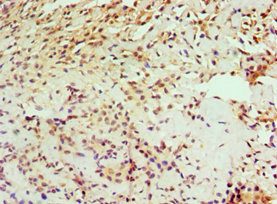
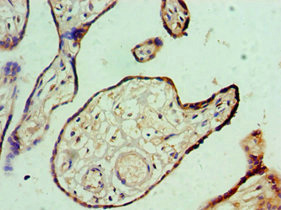
-
Chinese (Simplified)
-
English
-
German
-
Korean
-
Spanish

Chinese (Simplified)
English
German
Korean
Spanish
Sign up for an account to enjoy easy online shopping and instant order tracking.
The antibody against IL1RAP was raised in rabbit using the Recombinant Human Interleukin-1 receptor accessory protein (21-356AA) as the immunogen. This antibody exists as a non-conjugated isotype IgG, Antigen affinity purified. This antibody has been validated on ELISA, IHC.
$299.00
| Cat.No | ADC-44417A | Clonality | Polyclonal |
|---|---|---|---|
| Host Species | Rabbit | Target Name | IL1RAP |
| Form | Liquid | Species Reactivity | Human |
| Isotype | IgG | Storage Buffer | 50% Glycerol, PBS with 0.02% sodium azide, pH7.3. |
| Purification Method | Antigen affinity purified | Conjugate | Non-conjugated |
| Application | ELISA, IHC | Storage | Upon receipt |
| Immunogen Description | Recombinant Human Interleukin-1 receptor accessory protein (21-356AA) | Target Species | Human |
|---|---|---|---|
| Immunogen Sequence | Complete sequences for the immunogen, target protein, and peptides are available upon request. | Uniprot ID | Q9NPH3 |
Uniprot Id
Q9NPH3
Target Species
Human
Target Name
IL1RAP
Target Full Name
Interleukin-1 receptor accessory protein
Target Function
Coreceptor for IL1RL2 in the IL-36 signaling system. Coreceptor with IL1R1 in the IL-1 signaling system. Associates with IL1R1 bound to IL1B to form the high affinity interleukin-1 receptor complex which mediates interleukin-1-dependent activation of NF-kappa-B and other pathways. Signaling involves the recruitment of adapter molecules such as TOLLIP, MYD88, and IRAK1 or IRAK2 via the respective TIR domains of the receptor/coreceptor subunits. Recruits TOLLIP to the signaling complex. Does not bind to interleukin-1 alone; binding of IL1RN to IL1R1, prevents its association with IL1R1 to form a signaling complex. The cellular response is modulated through a non-signaling association with the membrane IL1R2 decoy receptor. Coreceptor for IL1RL1 in the IL-33 signaling system. Can bidirectionally induce pre- and postsynaptic differentiation of neurons by trans-synaptically binding to PTPRD. May play a role in IL1B-mediated costimulation of IFNG production from T-helper 1 (Th1) cells (Probable).; Associates with secreted ligand-bound IL1R2 and increases the affinity of secreted IL1R2 for IL1B; this complex formation may be the dominant mechanism for neutralization of IL1B by secreted/soluble receptors. Enhances the ability of secreted IL1R1 to inhibit IL-33 signaling.; Unable to mediate canonical IL-1 signaling. Required for Src phosphorylation by IL1B. May be involved in IL1B-potentiated NMDA-induced calcium influx in neurons.
Target Subcellular Location
[Isoform 1]: Cell membrane; Single-pass type I membrane protein.; [Isoform 2]: Secreted.; [Isoform 3]: Secreted.
Target Protein Families
Interleukin-1 receptor family
Target Tissue Specificity
Detected in liver, skin, placenta, thymus and lung. Isoform 4 is predominantly expressed in brain. Overexpressed on candidate chronic myeloid leukemia (CML) stem cells, hematopoietic stem cells and mononuclear cells of patients with acute myeloid leukemia
Target Synonyms
C3orf13; FLJ37788; IL 1 receptor accessory protein; IL 1R 3; IL 1R3; IL 1RAcP; IL 1RAP; IL-1 receptor accessory protein; IL-1R-3; IL-1R3; IL-1RAcP; IL-1RAP; IL1 receptor accessory protein; IL1AP_HUMAN; IL1R3; IL1RAcP; Il1rap; Interleukin 1 Accessory Protein; interleukin 1 receptor 3; Interleukin 1 receptor accessory protein; interleukin 1 receptor accessory protein beta; Interleukin-1 receptor 3; Interleukin-1 receptor accessory protein
Target Background
This gene encodes a component of the interleukin 1 receptor complex, which initiates signalling events that result in the activation of interleukin 1-responsive genes. Alternative splicing of this gene results in membrane-bound and soluble isoforms differing in their C-terminus. The ratio of soluble to membrane-bound forms increases during acute-phase induction or stress.
Notification