-
Chinese (Simplified)
-
English
-
German
-
Korean
-
Spanish

Chinese (Simplified)
English
German
Korean
Spanish
Sign up for an account to enjoy easy online shopping and instant order tracking.
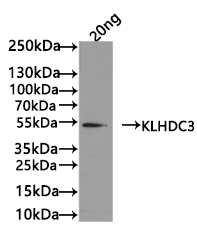
The antibody against KLHDC3 was raised in rabbit using the Recombinant Homo sapiens KLHDC3 protein (1-382aa) as the immunogen. This antibody exists as a non-conjugated isotype IgG, Affinity-chromatography purified. This antibody has been validated on ELISA, WB.
$299.00
| Cat.No | ADC-54724A | Clonality | Polyclonal |
|---|---|---|---|
| Host Species | Rabbit | Target Name | KLHDC3 |
| Target Synonyms | Kelch domain-containing protein 3 (Protein Peas) (Testis intracellular mediator protein), KLHDC3, PEAS | Form | Liquid |
| Species Reactivity | Homo sapiens | Isotype | IgG |
| Storage Buffer | 0.01M PBS, 0.03% Proclin 300; Constituents: 50% Glycerol, PH 7.4 | Purification Method | Affinity-chromatography purified |
| Conjugate | Non-conjugated | Application | ELISA, WB |
| Storage | Upon receipt |
| Immunogen Description | Recombinant Homo sapiens KLHDC3 protein (1-382aa) | Target Species | Human |
|---|---|---|---|
| Immunogen Sequence | Complete sequences for the immunogen, target protein, and peptides are available upon request. | Uniprot ID | Q9BQ90 |
Uniprot Id
Q9BQ90
Target Species
Human
Target Name
KLHDC3
Target Full Name
Kelch domain-containing protein 3
Target Function
Substrate-recognition component of a Cul2-RING (CRL2) E3 ubiquitin-protein ligase complex of the DesCEND (destruction via C-end degrons) pathway, which recognizes a C-degron located at the extreme C terminus of target proteins, leading to their ubiquitination and degradation. The C-degron recognized by the DesCEND pathway is usually a motif of less than ten residues and can be present in full-length proteins, truncated proteins or proteolytically cleaved forms. The CRL2(KLHDC3) complex specifically recognizes proteins with a glycine (Gly) at the C-terminus, leading to their ubiquitination and degradation: recognizes the C-terminal -Arg-(Xaa)n-Arg-Gly, -Arg-(Xaa)n-Lys-Gly, and -Arg-(Xaa)n-Gln-Gly degrons. The CRL2(KLHDC3) complex mediates ubiquitination and degradation of truncated SELENOV and SEPHS2 selenoproteins produced by failed UGA/Sec decoding, which end with a glycine. May be involved in meiotic recombination process.
Target Subcellular Location
Cytoplasm.
Target Research Area
Epigenetics and Nuclear Signaling
Target Synonyms
dJ20C7.3; hPEAS; kelch domain containing 3; Kelch domain-containing protein 3; KLDC3_HUMAN; KLHDC3; PEAS; Protein Peas; RP1-20C7.3; Testis intracellular mediator protein
Target Background
The protein encoded by this gene contains six repeated kelch motifs that are structurally similar to recombination activating gene 2, a protein involved in the activation of the V(D)J recombination. In mouse, this gene is found to be expressed specifically in testis. Its expression in pachytene spermatocytes is localized to cytoplasma and meiotic chromatin, suggesting that this gene may be involved in meiotic recombination.
Notification