• Contact info@abtriva.com for inquiries and orders.
  • Chinese (Simplified)

  • English

  • German

  • Korean

  • Spanish

United States (English / $ USD)

Rabbit anti-Human LGALS9 Polyclonal Antibody

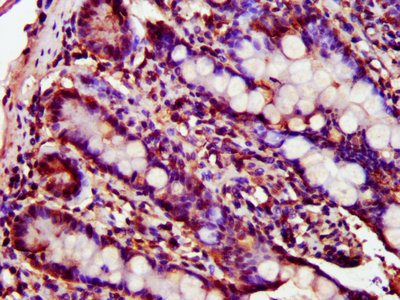
The antibody against LGALS9 was raised in rabbit using the Recombinant Human Galectin-9 protein (1-323AA) as the immunogen. This antibody exists as a non-conjugated isotype IgG, purified by protein G with a purity greater than 95%. This antibody has been validated on ELISA, WB, IHC, IF.

ADC-49745A

The antibody against LGALS9 was raised in rabbit using the Recombinant Human Galectin-9 protein (1-323AA) as the immunogen. This antibody exists as a non-conjugated isotype IgG, purified by protein G with a purity greater than 95%. This antibody has been validated on ELISA, WB, IHC, IF.

$299.00

Number
Order Exclusive Products Now

Request a Quote
High Purity LevelsPrecision and ReliabilityCustomization Options

Specifications


Cat.No ADC-49745A ClonalityPolyclonal
Host SpeciesRabbitTarget NameLGALS9
FormLiquidSpecies ReactivityHuman, Mouse
IsotypeIgGStorage Buffer0.01M PBS, 0.03% Proclin 300; Constituents: 50% Glycerol, PH 7.4
Purification Method>95%, Protein G purifiedConjugateNon-conjugated
ApplicationELISA, IF, IHC, WBStorageUpon receipt

Immunogen Information


Immunogen DescriptionRecombinant Human Galectin-9 protein (1-323AA)Target SpeciesHuman
Immunogen SequenceComplete sequences for the immunogen, target protein, and peptides are available upon request.Uniprot IDO00182
Background Information
  • Uniprot Id

    O00182

  • Target Species

    Human

  • Target Name

    LGALS9

  • Target Full Name

    Galectin-9

  • Target Function

    Binds galactosides. Has high affinity for the Forssman pentasaccharide. Ligand for HAVCR2/TIM3. Binding to HAVCR2 induces T-helper type 1 lymphocyte (Th1) death. Also stimulates bactericidal activity in infected macrophages by causing macrophage activation and IL1B secretion which restricts intracellular bacterial growth. Ligand for P4HB; the interaction retains P4HB at the cell surface of Th2 T-helper cells, increasing disulfide reductase activity at the plasma membrane, altering the plasma membrane redox state and enhancing cell migration. Ligand for CD44; the interaction enhances binding of SMAD3 to the FOXP3 promoter, leading to up-regulation of FOXP3 expression and increased induced regulatory T (iTreg) cell stability and suppressive function. Promotes ability of mesenchymal stromal cells to suppress T-cell proliferation. Expands regulatory T-cells and induces cytotoxic T-cell apoptosis following virus infection. Activates ERK1/2 phosphorylation inducing cytokine (IL-6, IL-8, IL-12) and chemokine (CCL2) production in mast and dendritic cells. Inhibits degranulation and induces apoptosis of mast cells. Induces maturation and migration of dendritic cells. Inhibits natural killer (NK) cell function. Can transform NK cell phenotype from peripheral to decidual during pregnancy. Astrocyte derived galectin-9 enhances microglial TNF production. May play a role in thymocyte-epithelial interactions relevant to the biology of the thymus. May provide the molecular basis for urate flux across cell membranes, allowing urate that is formed during purine metabolism to efflux from cells and serving as an electrogenic transporter that plays an important role in renal and gastrointestinal urate excretion. Highly selective to the anion urate.; Acts as an eosinophil chemoattractant. It also inhibits angiogenesis. Suppresses IFNG production by natural killer cells.

  • Target Subcellular Location

    Cytoplasm. Nucleus. Secreted.; [Isoform 2]: Secreted.; [Isoform 3]: Secreted.

  • Target Tissue Specificity

    Peripheral blood leukocytes and lymphatic tissues. Expressed in lung, liver, breast and kidney with higher levels in tumor endothelial cells than normal endothelium (at protein level). Expressed in trophoblast cells in decidua and placenta in pregnancy (a

  • Target Research Area

    Cell Biology, Neuroscience

  • Target Synonyms

    36 kDa beta-galactoside-binding lectin; Ecalectin; Gal-9; galectin 9; Galectin-9; galectin9; HOM HD 21; HOMHD21; HUAT; Lectin galactoside binding soluble 9; LEG9_HUMAN; LGAL S9; LGALS 9; Lgals9; LGALS9A; MGC117375; MGC125973; MGC125974; Tumor antigen HOM-HD-21; UAT; Urate transporter/channel; Urate transporter/channel protein

  • Target Background

    The galectins are a family of beta-galactoside-binding proteins implicated in modulating cell-cell and cell-matrix interactions. The protein encoded by this gene is an S-type lectin. It is overexpressed in Hodgkin's disease tissue and might participate in the interaction between the H&RS cells with their surrounding cells and might thus play a role in the pathogenesis of this disease and/or its associated immunodeficiency. Multiple alternatively spliced transcript variants have been found for this gene.

Inquire Rabbit anti-Human LGALS9 Polyclonal Antibody Now


AbTriva respects your privacy and protects your personal data in accordance with AbTriva. For more information, please see our data protection statement. *

Notification