-
Chinese (Simplified)
-
English
-
German
-
Korean
-
Spanish
Chinese (Simplified)
English
German
Korean
Spanish
Sign up for an account to enjoy easy online shopping and instant order tracking.
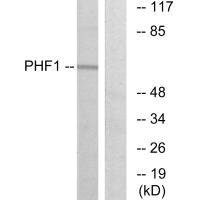
The antibody against PHF1 was raised in rabbit using the Synthesized peptide derived from internal of Human PHF1. as the immunogen. The antibody was affinity-purified from rabbit antiserum by affinity-chromatography using epitope-specific immunogen. This antibody has been validated on ELISA, WB.
$297.00
| Cat.No | ADC-42234A | Clonality | Polyclonal |
|---|---|---|---|
| Host Species | Rabbit | Target Name | PHF1 |
| Form | Liquid | Species Reactivity | Human, Mouse, Rat |
| Storage Buffer | PH 7.4, 0.02% sodium azide and 50% glycerol., 150mM NaCl, Rabbit IgG in phosphate buffered saline (without Mg2+ and Ca2+) | Purification Method | The antibody was affinity-purified from rabbit antiserum by affinity-chromatography using epitope-specific immunogen. |
| Application | ELISA, WB | Storage | Upon receipt |
| Immunogen Description | Synthesized peptide derived from internal of Human PHF1. | Target Species | Human |
|---|---|---|---|
| Immunogen Sequence | Complete sequences for the immunogen, target protein, and peptides are available upon request. | Uniprot ID | O43189 |
Uniprot Id
O43189
Target Species
Human
Target Name
PHF1
Target Full Name
PHD finger protein 1
Target Function
Polycomb group (PcG) that specifically binds histone H3 trimethylated at 'Lys-36' (H3K36me3) and recruits the PRC2 complex. Involved in DNA damage response and is recruited at double-strand breaks (DSBs). Acts by binding to H3K36me3, a mark for transcriptional activation, and recruiting the PRC2 complex: it is however unclear whether recruitment of the PRC2 complex to H3K36me3 leads to enhance or inhibit H3K27me3 methylation mediated by the PRC2 complex. According to some reports, PRC2 recruitment by PHF1 promotes H3K27me3 and subsequent gene silencing by inducing spreading of PRC2 and H3K27me3 into H3K36me3 loci. According to another report, PHF1 recruits the PRC2 complex at double-strand breaks (DSBs) and inhibits the activity of PRC2. Regulates p53/TP53 stability and prolonges its turnover: may act by specifically binding to a methylated from of p53/TP53.
Target Involvement
A chromosomal aberration involving PHF1 may be a cause of endometrial stromal tumors. Translocation t(6;7)(p21;p22) with JAZF1. Translocation t(1;6)(p34;p21) with MEAF6.
Target Subcellular Location
Nucleus. Cytoplasm, cytoskeleton, microtubule organizing center, centrosome. Note=Localizes specifically to the promoters of numerous target genes. Localizes to double-strand breaks (DSBs) sites following DNA damage. Co-localizes with NEK6 in the centrosome.
Target Protein Families
Polycomblike family
Target Tissue Specificity
Highest levels in heart, skeletal muscle, and pancreas, lower levels in brain, placenta, lung, liver and kidney.
Target Synonyms
hPCl1; MTF2 L2; MTF2L 2; MTF2L2; PCL 1; PCL1; PHD finger protein 1; PHD finger protein1; PHF 1; PHF 2; Phf1; PHF1_HUMAN; PHF2; Plc 1; Plc1; Polycomb like protein 1; Polycomb like protein1; Polycomb-like protein 1; Protein PHF1; T complex testis expressed 3; T complex testis expressed3; Tctex 3; Tctex3
Target Background
This gene encodes a Polycomb group protein. The protein is a component of a histone H3 lysine-27 (H3K27)-specific methyltransferase complex, and functions in transcriptional repression of homeotic genes. The protein is also recruited to double-strand breaks, and reduced protein levels results in X-ray sensitivity and increased homologous recombination. Multiple transcript variants encoding different isoforms have been found for this gene.
Notification