• Contact info@abtriva.com for inquiries and orders.
  • Chinese (Simplified)

  • English

  • German

  • Korean

  • Spanish

United States (English / $ USD)

Rabbit anti-Human POU4F Polyclonal Antibody

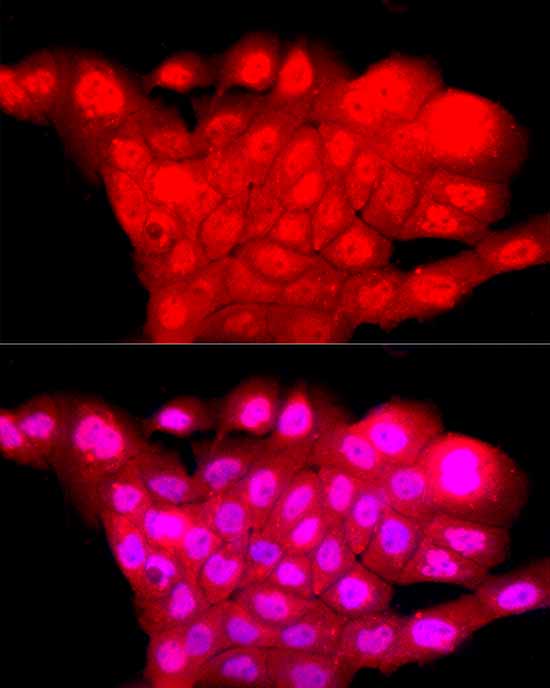
The antibody against POU4F was raised in Rabbit using the recombinant protein of human POU4F1 as the immunogen. The polyclonal antibody exists as a isotype IgG, by affinity purification. This antibody has been validated on IF/ICC, ELISA.

ADA-08020A

The antibody against POU4F was raised in Rabbit using the recombinant protein of human POU4F1 as the immunogen. The polyclonal antibody exists as a isotype IgG, by affinity purification. This antibody has been validated on IF/ICC, ELISA.

Number
Order Exclusive Products Now

Request a Quote
High Purity LevelsPrecision and ReliabilityCustomization Options

Specifications


Cat.No ADA-08020A ClonalityPolyclonal
Host SpeciesRabbitTarget NamePOU4F
Target SynonymsBRN3A; RDC-1; ATITHS; Oct-T1; brn-3AFormLiquid
Species ReactivityHuman, Mouse, RatIsotypeIgG
Storage Buffer50% Glycerol, PBS with 0.05% proclin300, pH7.3.Purification MethodAffinity purification
Positive SamplesMouse lung, Rat lungApplicationELISA, IF/ICC

Immunogen Information


Immunogen DescriptionRecombinant protein of human POU4F1.Target SpeciesHuman
Immunogen SequenceComplete sequences for the immunogen, target protein, and peptides are available upon request.Uniprot IDQ01851
Background Information
  • Uniprot Id

    Q01851

  • Target Species

    Human

  • Target Name

    POU4F1

  • Target Full Name

    POU domain, class 4, transcription factor 1

  • Target Function

    Multifunctional transcription factor with different regions mediating its different effects. Acts by binding (via its C-terminal domain) to sequences related to the consensus octamer motif 5'-ATGCAAAT-3' in the regulatory regions of its target genes. Regulates the expression of specific genes involved in differentiation and survival within a subset of neuronal lineages. It has been shown that activation of some of these genes requires its N-terminal domain, maybe through a neuronal-specific cofactor. Ativates BCL2 expression and protects neuronal cells from apoptosis (via the N-terminal domain). Induces neuronal process outgrowth and the coordinate expression of genes encoding synaptic proteins. Exerts its major developmental effects in somatosensory neurons and in brainstem nuclei involved in motor control. Stimulates the binding affinity of the nuclear estrogene receptor ESR1 to DNA estrogen response element (ERE), and hence modulates ESR1-induced transcriptional activity. May positively regulate POU4F2 and POU4F3. Regulates dorsal root ganglion sensory neuron specification and axonal projection into the spinal cord. Plays a role in TNFSF11-mediated terminal osteoclast differentiation. Negatively regulates its own expression interacting directly with a highly conserved autoregulatory domain surrounding the transcription initiation site.; Able to act as transcription factor, cannot regulate the expression of the same subset of genes than isoform 1. Does not have antiapoptotic effect on neuronal cells.

  • Target Subcellular Location

    Nucleus. Cytoplasm.

  • Target Protein Families

    POU transcription factor family, Class-4 subfamily

  • Target Tissue Specificity

    Expressed in the brain and the retina. Present in the developing brain, spinal cord and eye.

  • Target Synonyms

    BRN3A; RDC-1; ATITHS; Oct-T1; brn-3A

  • Target Background

    This gene encodes a member of the POU-IV class of neural transcription factors. This protein is expressed in a subset of retinal ganglion cells and may be involved in the developing sensory nervous system. This protein may also promote the growth of cervical tumors. A translocation of this gene is associated with some adult acute myeloid leukemias.

Inquire Rabbit anti-Human POU4F Polyclonal Antibody Now


AbTriva respects your privacy and protects your personal data in accordance with AbTriva. For more information, please see our data protection statement. *

Notification