-
Chinese (Simplified)
-
English
-
German
-
Korean
-
Spanish
Chinese (Simplified)
English
German
Korean
Spanish
Sign up for an account to enjoy easy online shopping and instant order tracking.
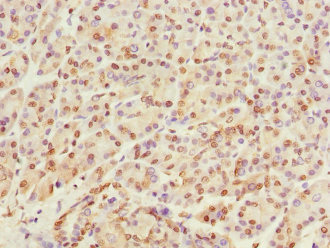
The antibody against PTPRO was raised in rabbit using the Recombinant Human Receptor-type tyrosine-protein phosphatase O protein (30-300AA) as the immunogen. This antibody exists as a non-conjugated isotype IgG, Antigen affinity purified. This antibody has been validated on ELISA, IHC.
$299.00
| Cat.No | ADC-17323A | Clonality | Polyclonal |
|---|---|---|---|
| Host Species | Rabbit | Target Name | PTPRO |
| Form | Liquid | Species Reactivity | Human |
| Isotype | IgG | Storage Buffer | 50% Glycerol, PBS with 0.02% sodium azide, pH7.3. |
| Purification Method | Antigen affinity purified | Conjugate | Non-conjugated |
| Application | ELISA, IHC | Storage | Upon receipt |
| Immunogen Description | Recombinant Human Receptor-type tyrosine-protein phosphatase O protein (30-300AA) | Target Species | Human |
|---|---|---|---|
| Immunogen Sequence | Complete sequences for the immunogen, target protein, and peptides are available upon request. | Uniprot ID | Q16827 |
Uniprot Id
Q16827
Target Species
Human
Target Name
PTPRO
Target Full Name
Receptor-type tyrosine-protein phosphatase O
Target Function
Possesses tyrosine phosphatase activity. Plays a role in regulating the glomerular pressure/filtration rate relationship through an effect on podocyte structure and function.
Target Involvement
Nephrotic syndrome 6 (NPHS6)
Target Subcellular Location
Membrane; Single-pass type I membrane protein.
Target Protein Families
Protein-tyrosine phosphatase family, Receptor class 3 subfamily
Target Tissue Specificity
Glomerulus of kidney. Also detected in brain, lung and placenta.
Target Synonyms
FMI; GLEPP 1; Glomerular epithelial protein 1; hPTP-J; Pancreatic carcinoma phosphatase 2; PCP-2; PCP2; Phosphotyrosine phosphatase U2; Protein tyrosine phosphatase PTP U2; Protein tyrosine phosphatase PTPU2; Protein tyrosine phosphatase receptor type O; Protein tyrosine phosphatase U2; Protein-tyrosine phosphatase J; Protein-tyrosine phosphatase pi; Protein-tyrosine phosphatase receptor omicron; PTP pi; PTP U2; PTP-J; PTP-RO; PTP-U2; PTPase U2; PTPRO; PTPRO_HUMAN; PTPROt; PTPU 2; PTPU2; R-PTP-O; R-PTP-psi; Receptor type protein tyrosine phosphatase O; Receptor type tyrosine protein phosphatase O; Receptor-type protein-tyrosine phosphatase psi; Receptor-type tyrosine-protein phosphatase O; Receptor-type tyrosine-protein phosphatase U
Target Background
This gene encodes a member of the R3 subtype family of receptor-type protein tyrosine phosphatases. These proteins are localized to the apical surface of polarized cells and may have tissue-specific functions through activation of Src family kinases. This gene contains two distinct promoters, and alternatively spliced transcript variants encoding multiple isoforms have been observed. The encoded proteins may have multiple isoform-specific and tissue-specific functions, including the regulation of osteoclast production and activity, inhibition of cell proliferation and facilitation of apoptosis. This gene is a candidate tumor suppressor, and decreased expression of this gene has been observed in several types of cancer.
Notification