-
Chinese (Simplified)
-
English
-
German
-
Korean
-
Spanish
Chinese (Simplified)
English
German
Korean
Spanish
Sign up for an account to enjoy easy online shopping and instant order tracking.
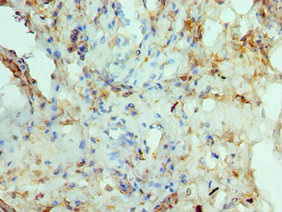
The antibody against RAD51D was raised in rabbit using the Recombinant Human DNA repair protein RAD51 homolog 4 protein (1-328AA) as the immunogen. This antibody exists as a non-conjugated isotype IgG, Antigen affinity purified. This antibody has been validated on ELISA, WB, IHC.
$299.00
| Cat.No | ADC-44572A | Clonality | Polyclonal |
|---|---|---|---|
| Host Species | Rabbit | Target Name | RAD51D |
| Target Synonyms | D antibody; RAD51-like protein 3 antibody; Rad51l3 antibody; Recombination repair protein antibody; S. cerevisiae RAD51-like 3 antibody; TRAD antibody, homolog of, S. cerevisiae | Form | Liquid |
| Species Reactivity | Human | Isotype | IgG |
| Storage Buffer | 50% Glycerol, PBS with 0.02% sodium azide, pH7.3. | Purification Method | Antigen affinity purified |
| Conjugate | Non-conjugated | Application | ELISA, IHC, WB |
| Storage | Upon receipt |
| Immunogen Description | Recombinant Human DNA repair protein RAD51 homolog 4 protein (1-328AA) | Target Species | Human |
|---|---|---|---|
| Immunogen Sequence | Complete sequences for the immunogen, target protein, and peptides are available upon request. | Uniprot ID | O75771 |
Uniprot Id
O75771
Target Species
Human
Target Name
RAD51D
Target Full Name
DNA repair protein RAD51 homolog 4
Target Function
Involved in the homologous recombination repair (HRR) pathway of double-stranded DNA breaks arising during DNA replication or induced by DNA-damaging agents. Bind to single-stranded DNA (ssDNA) and has DNA-dependent ATPase activity. Part of the Rad21 paralog protein complex BCDX2 which acts in the BRCA1-BRCA2-dependent HR pathway. Upon DNA damage, BCDX2 acts downstream of BRCA2 recruitment and upstream of RAD51 recruitment. BCDX2 binds predominantly to the intersection of the four duplex arms of the Holliday junction and to junction of replication forks. The BCDX2 complex was originally reported to bind single-stranded DNA, single-stranded gaps in duplex DNA and specifically to nicks in duplex DNA. Involved in telomere maintenance. The BCDX2 subcomplex XRCC2:RAD51D can stimulate Holliday junction resolution by BLM.
Target Involvement
Breast-ovarian cancer, familial, 4 (BROVCA4)
Target Subcellular Location
Nucleus. Cytoplasm, cytoskeleton, microtubule organizing center, centrosome. Chromosome, telomere.
Target Protein Families
RecA family, RAD51 subfamily
Target Tissue Specificity
Expressed in colon, prostate, spleen, testis, ovary, thymus and small intestine. Weakly expressed in leukocytes.
Target Research Area
Epigenetics and Nuclear Signaling
Target Synonyms
BROVCA4; DNA repair protein RAD51 homolog 4; HsTRAD; OTTHUMP00000163851; OTTHUMP00000163852; OTTHUMP00000163853; R51H3; RA51D_HUMAN; RAD51 homolog D (S. cerevisiae); RAD51 homolog D; RAD51 like 3 (S. cerevisiae); RAD51 paralog D; RAD51, S. cerevisiae, homolog of, D; RAD51-like protein 3; Rad51l3; Recombination repair protein; S. cerevisiae RAD51-like 3; TRAD
Target Background
The protein encoded by this gene is a member of the RAD51 protein family. RAD51 family members are highly similar to bacterial RecA and Saccharomyces cerevisiae Rad51, which are known to be involved in the homologous recombination and repair of DNA. This protein forms a complex with several other members of the RAD51 family, including RAD51L1, RAD51L2, and XRCC2. The protein complex formed with this protein has been shown to catalyze homologous pairing between single- and double-stranded DNA, and is thought to play a role in the early stage of recombinational repair of DNA. Alternative splicing results in multiple transcript variants. Read-through transcription also exists between this gene and the downstream ring finger and FYVE-like domain containing 1 (RFFL) gene.
Notification