-
Chinese (Simplified)
-
English
-
German
-
Korean
-
Spanish
Chinese (Simplified)
English
German
Korean
Spanish
Sign up for an account to enjoy easy online shopping and instant order tracking.
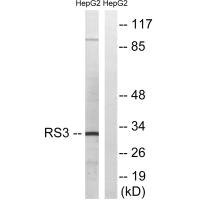
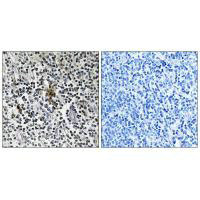
The antibody against RPS3 was raised in rabbit using the Synthesized peptide derived from internal of Human RPS3. as the immunogen. The antibody was affinity-purified from rabbit antiserum by affinity-chromatography using epitope-specific immunogen. This antibody has been validated on ELISA, WB, IHC.
$297.00
| Cat.No | ADC-41558A | Clonality | Polyclonal |
|---|---|---|---|
| Host Species | Rabbit | Target Name | RPS3 |
| Form | Liquid | Species Reactivity | Human, Mouse |
| Storage Buffer | PH 7.4, 0.02% sodium azide and 50% glycerol., 150mM NaCl, Rabbit IgG in phosphate buffered saline (without Mg2+ and Ca2+) | Purification Method | The antibody was affinity-purified from rabbit antiserum by affinity-chromatography using epitope-specific immunogen. |
| Application | ELISA, IHC, WB | Storage | Upon receipt |
| Immunogen Description | Synthesized peptide derived from internal of Human RPS3. | Target Species | Human |
|---|---|---|---|
| Immunogen Sequence | Complete sequences for the immunogen, target protein, and peptides are available upon request. | Uniprot ID | P23396 |
Uniprot Id
P23396
Target Species
Human
Target Name
RPS3
Target Full Name
Small ribosomal subunit protein uS3
Target Function
Involved in translation as a component of the 40S small ribosomal subunit. Has endonuclease activity and plays a role in repair of damaged DNA. Cleaves phosphodiester bonds of DNAs containing altered bases with broad specificity and cleaves supercoiled DNA more efficiently than relaxed DNA. Displays high binding affinity for 7,8-dihydro-8-oxoguanine (8-oxoG), a common DNA lesion caused by reactive oxygen species (ROS). Has also been shown to bind with similar affinity to intact and damaged DNA. Stimulates the N-glycosylase activity of the base excision protein OGG1. Enhances the uracil excision activity of UNG1. Also stimulates the cleavage of the phosphodiester backbone by APEX1. When located in the mitochondrion, reduces cellular ROS levels and mitochondrial DNA damage. Has also been shown to negatively regulate DNA repair in cells exposed to hydrogen peroxide. Plays a role in regulating transcription as part of the NF-kappa-B p65-p50 complex where it binds to the RELA/p65 subunit, enhances binding of the complex to DNA and promotes transcription of target genes. Represses its own translation by binding to its cognate mRNA. Binds to and protects TP53/p53 from MDM2-mediated ubiquitination. Involved in spindle formation and chromosome movement during mitosis by regulating microtubule polymerization. Involved in induction of apoptosis through its role in activation of CASP8. Induces neuronal apoptosis by interacting with the E2F1 transcription factor and acting synergistically with it to up-regulate pro-apoptotic proteins BCL2L11/BIM and HRK/Dp5. Interacts with TRADD following exposure to UV radiation and induces apoptosis by caspase-dependent JNK activation.
Target Subcellular Location
Cytoplasm. Nucleus. Nucleus, nucleolus. Mitochondrion inner membrane; Peripheral membrane protein. Cytoplasm, cytoskeleton, spindle.
Target Protein Families
Universal ribosomal protein uS3 family
Target Research Area
Others
Target Synonyms
40S ribosomal protein S3; fb13d09; FLJ26283; FLJ27450; IMR 90 ribosomal protein S3; MGC56088; MGC87870; OTTHUMP00000229804; OTTHUMP00000229805; OTTHUMP00000229874; OTTHUMP00000229877; OTTHUMP00000229878; OTTHUMP00000229879; OTTHUMP00000229880; OTTHUMP00000229882; OTTHUMP00000229883; OTTHUMP00000229886; Ribosomal protein S3; rps3; RS3_HUMAN; S3; wu:fb13d09; zgc:56088
Target Background
Ribosomes, the organelles that catalyze protein synthesis, consist of a small 40S subunit and a large 60S subunit. Together these subunits are composed of 4 RNA species and approximately 80 structurally distinct proteins. This gene encodes a ribosomal protein that is a component of the 40S subunit, where it forms part of the domain where translation is initiated. The protein belongs to the S3P family of ribosomal proteins. Studies of the mouse and rat proteins have demonstrated that the protein has an extraribosomal role as an endonuclease involved in the repair of UV-induced DNA damage. The protein appears to be located in both the cytoplasm and nucleus but not in the nucleolus. Higher levels of expression of this gene in colon adenocarcinomas and adenomatous polyps compared to adjacent normal colonic mucosa have been observed. This gene is co-transcribed with the small nucleolar RNA genes U15A and U15B, which are located in its first and fifth introns, respectively. As is typical for genes encoding ribosomal proteins, there are multiple processed pseudogenes of this gene dispersed through the genome. Multiple alternatively spliced transcript variants encoding different isoforms have been found for this gene.
Notification