• Contact info@abtriva.com for inquiries and orders.
  • Chinese (Simplified)

  • English

  • German

  • Korean

  • Spanish

United States (English / $ USD)

Rabbit anti-Human SLC4A10/SLC4A8 Polyclonal Antibody

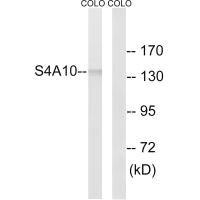
The antibody against SLC4A10/SLC4A8 was raised in rabbit using the Synthesized peptide derived from internal of Human SLC4A8/10. as the immunogen. The antibody was affinity-purified from rabbit antiserum by affinity-chromatography using epitope-specific immunogen. This antibody has been validated on ELISA, WB.

ADC-40891A

The antibody against SLC4A10/SLC4A8 was raised in rabbit using the Synthesized peptide derived from internal of Human SLC4A8/10. as the immunogen. The antibody was affinity-purified from rabbit antiserum by affinity-chromatography using epitope-specific immunogen. This antibody has been validated on ELISA, WB.

$297.00

Number
Order Exclusive Products Now

Request a Quote
High Purity LevelsPrecision and ReliabilityCustomization Options

Specifications


Cat.No ADC-40891A ClonalityPolyclonal
Host SpeciesRabbitTarget NameSLC4A10/SLC4A8
Target Synonymsmember 10 antibody, member 10 antibody; Solute carrier family 4, sodium bicarbonate cotransporter like, sodium bicarbonate transporter, sodium bicarbonate transporter likeFormLiquid
Species ReactivityHuman, MouseStorage BufferPH 7.4, 0.02% sodium azide and 50% glycerol., 150mM NaCl, Rabbit IgG in phosphate buffered saline (without Mg2+ and Ca2+)
Purification MethodThe antibody was affinity-purified from rabbit antiserum by affinity-chromatography using epitope-specific immunogen.ApplicationELISA, WB
StorageUpon receipt

Immunogen Information


Immunogen DescriptionSynthesized peptide derived from internal of Human SLC4A8/10.Target SpeciesHuman
Immunogen SequenceComplete sequences for the immunogen, target protein, and peptides are available upon request.Uniprot IDQ6U841
Background Information
  • Uniprot Id

    Q6U841

  • Target Species

    Human

  • Target Name

    SLC4A10

  • Target Full Name

    Sodium-driven chloride bicarbonate exchanger

  • Target Function

    Sodium/bicarbonate cotransporter which plays an important role in regulating intracellular pH. Has been shown to act as a sodium/bicarbonate cotransporter in exchange for intracellular chloride. Has also been shown to act as a sodium/biocarbonate cotransporter which does not couple net influx of bicarbonate to net efflux of chloride, with the observed chloride efflux being due to chloride self-exchange. Controls neuronal pH and may contribute to the secretion of cerebrospinal fluid. Reduces the excitability of CA1 pyramidal neurons and modulates short-term synaptic plasticity. Required in retinal cells to maintain normal pH which is necessary for normal vision. In the kidney, likely to mediate bicarbonate reclamation in the apical membrane of the proximal tubules.

  • Target Subcellular Location

    Basolateral cell membrane; Multi-pass membrane protein. Apical cell membrane; Multi-pass membrane protein. Cell projection, dendrite. Cell projection, axon. Perikaryon. Cell junction, synapse, presynapse. Cell junction, synapse, postsynapse.

  • Target Protein Families

    Anion exchanger (TC 2.A.31) family

  • Target Tissue Specificity

    Predominantly expressed in the brain.

  • Target Synonyms

    NBCn 2; NBCn2; NCBE; S4A10; S4A10_HUMAN; SLC 4A10; SLC4 A10; SLC4A 10; Slc4a10; Sodium driven chloride bicarbonate exchanger; Sodium-driven chloride bicarbonate exchanger; Solute carrier family 4 member 10; Solute carrier family 4, sodium bicarbonate cotransporter like, member 10; Solute carrier family 4, sodium bicarbonate transporter like, member 10; Solute carrier family 4, sodium bicarbonate transporter, member 10

  • Target Background

    This gene belongs to a small family of sodium-coupled bicarbonate transporters (NCBTs) that regulate the intracellular pH of neurons, the secretion of bicarbonate ions across the choroid plexus, and the pH of the brain extracellular fluid. The protein encoded by this gene was initially identified as a sodium-driven chloride bicarbonate exchanger (NCBE) though there is now evidence that its sodium/bicarbonate cotransport activity is independent of any chloride ion countertransport under physiological conditions. This gene is now classified as a member A10 of the SLC4 family of transmembrane solute carriers. Alternative splicing results in multiple transcript variants encoding distinct isoforms.

Inquire Rabbit anti-Human SLC4A10/SLC4A8 Polyclonal Antibody Now


AbTriva respects your privacy and protects your personal data in accordance with AbTriva. For more information, please see our data protection statement. *

Notification